Who Can Take ACLS Certification

Advanced Cardiovascular Life Support (ACLS) is one of the most trusted credentials in modern healthcare, giving clinicians the tools to recognize life-threatening emergencies. When a patient’s heart stops, rhythm changes, or breathing fails, ACLS is the structured, evidence-based system that helps you bring them back.
This professional milestone signals to employers that you’re prepared to step into high-pressure situations and deliver care that saves lives. ACLS is typically required for professionals working in high-acuity settings such as emergency departments, intensive care units (ICUs), telemetry units, operating rooms, and EMS.
Understanding who needs ACLS certification and why eligibility matters helps both new and experienced healthcare professionals plan their career path, meet employer requirements, and ensure they're fully prepared to step into critical roles with confidence. Your patients depend on you, and this training helps you meet that responsibility with skill, clarity, and calm.
What is ACLS Certification (advanced cardiovascular life support)?
Advanced Cardiovascular Life Support is an advanced clinical training program that prepares healthcare professionals to manage serious cardiovascular emergencies, such as cardiac arrest, stroke, respiratory failure, and dangerous arrhythmias.
ACLS follows evidence-based guidelines from the International Liaison Committee on Resuscitation (ILCOR), which means every skill, algorithm, and medication you learn reflects the most up-to-date science available.
ACLS vs. BLS: What’s the Difference?
Basic Life Support is foundational training that focuses on proficiency in first aid, early CPR, rapid defibrillation with an AED, and basic airway support. ACLS builds on the skills and knowledge with advanced assessment, rhythm interpretation, drug therapy, team leadership, and the ability to run a code from start to finish.
What ACLS Training Actually Covers
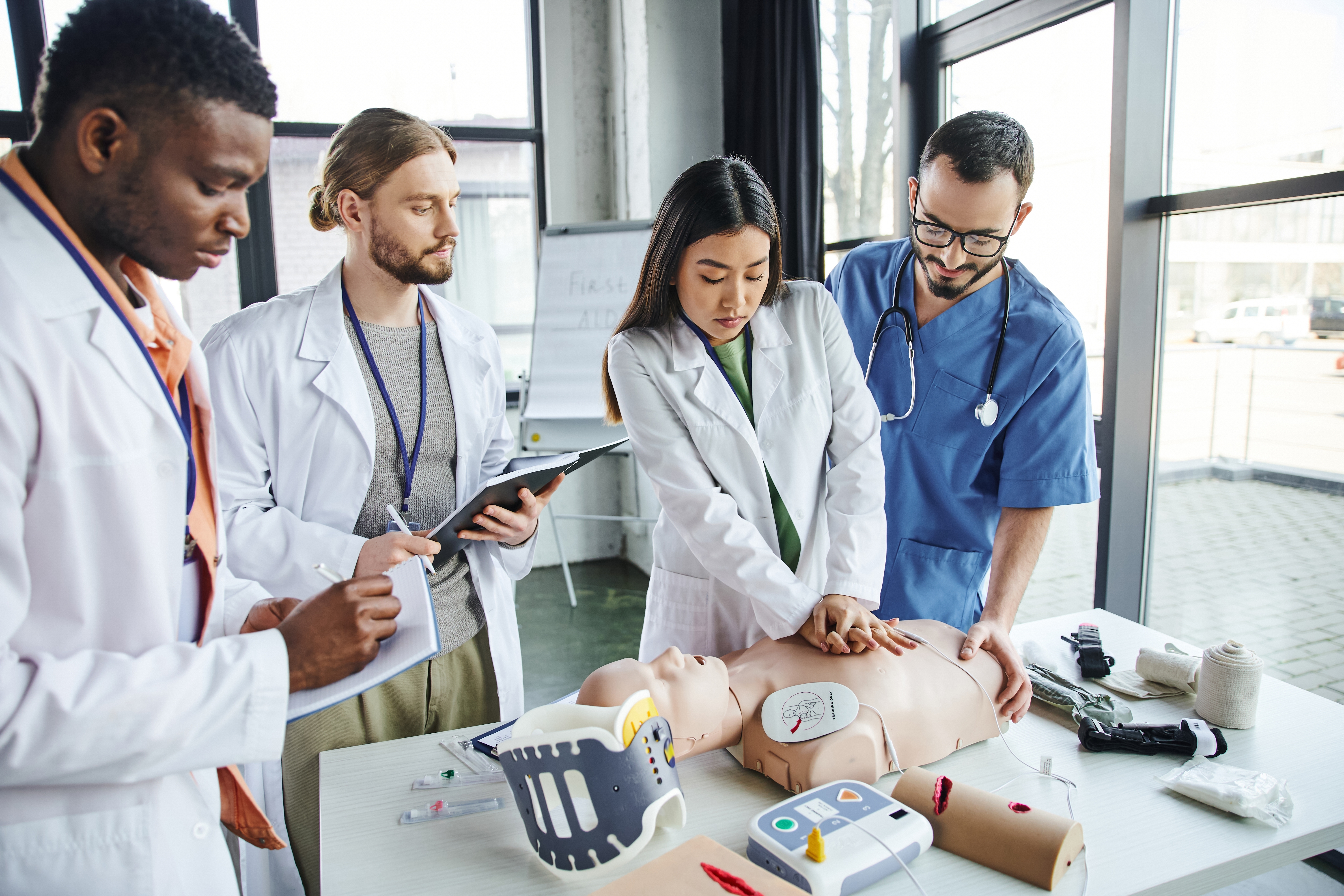
ACLS certification goes well beyond compressions and rescue breathing. Throughout the course, you learn how to:
- Interpret ECG rhythms quickly and accurately
- Manage airways using bag-mask ventilation, supraglottic devices, and other techniques
- Identify and treat shockable and non-shockable rhythms
- Use emergency medications such as epinephrine, amiodarone, atropine, and adenosine
- Run code scenarios (“megacodes”) with real-time decision-making
- Coordinate and lead a resuscitation teams
- Apply ACLS algorithms for cardiac arrest, bradycardia, tachycardia, acute coronary syndromes, and stroke
- Recognize reversible causes of cardiac arrest (the H’s and T’s) to correct what’s actually driving the emergency
ACLS gives you a structured approach so that when the room gets loud, alarms start sounding, and a patient’s life hangs in the balance, your training takes over.
Health Care Professionals Who Need ACLS
ACLS is designed for clinicians who routinely care for patients at risk of cardiac or respiratory compromise. These professionals are often the first to recognize deterioration and the first to act, including:
Nurses
Nurses are one of the largest groups who rely on ACLS training. They frequently manage unstable patients and respond to codes daily. Even in telemetry or step-down units, ACLS is often expected due to frequent rhythm changes and rapid interventions.
Physicians
Emergency physicians, critical care doctors, hospitalists, anesthesiologists, and cardiologists rely on ACLS daily. They often lead resuscitation efforts and need expert-level rhythm interpretation, medication management, and team coordination.
EMS Personnel
Paramedics, AEMTs, and flight nurses depend heavily on ACLS in the prehospital environment. They’re often the first clinicians on scene, treating patients at their most vulnerable moments. ACLS gives them the structured approach they need to manage emergencies long before the patient ever reaches a hospital.
ACLS Prerequisites and Requirements
To earn ACLS, you must first hold a current Basic Life Support (BLS) certification. High-quality CPR, early defibrillation, and rapid recognition of cardiac arrest are the cornerstones of every ACLS algorithm, so mastering these skills first is non-negotiable.
Since ACLS moves quickly, providers are expected to arrive with baseline familiarity in:
- ECG rhythm recognition: understanding shockable vs. non-shockable rhythms.
- Emergency pharmacology: when and why drugs like epinephrine, atropine, or amiodarone are used.
- Basic airway management: bag-mask ventilation and recognizing inadequate breathing.
Can Non-Medical Professionals Take an ACLS Course?
Technically, anyone can sign up for an ACLS course. There is no universal law restricting enrollment, but practically speaking, it’s intended for clinicians who are licensed to perform advanced medical care, rather than the general public.
For non-medical personnel, even those who complete the course, they cannot legally apply most ACLS interventions in real emergencies. Without a clinical license, they cannot give medications, work in a clinical capacity, or lead a resuscitation team. In other words, the certification may exist on paper, but it is highly unlikely to translate into usable responsibilities.
BLS, on the other hand, is an appropriate choice for non-clinicians since it focuses on skills that anyone can legally and effectively perform, such as CPR and AED use.
ACLS Requirements by Health Care Setting
ACLS requirements are shaped by the clinical environment and the kinds of emergencies a provider is likely to face. Some settings require ACLS as a condition of employment, while others merely encourage it to improve patient care.
Hospital Settings
ACLS is standard for teams working in high-acuity areas where cardiac arrest and rapid deterioration are common. These include the ICU, Emergency Department, and Operating Room. Even on Med-Surg floors, where patient acuity is typically lower, ACLS is often encouraged.
Outpatient Settings
Ambulatory surgery centers, dialysis clinics, and cardiac rehab facilities often maintain ACLS-trained staff because their patients may have underlying conditions that increase the risk of cardiac complications. While not every team member must be certified, these environments typically ensure that at least one ACLS-trained clinician is present whenever patients are receiving care.
Prehospital Settings
EMS agencies, paramedic units, and air medical transport teams rely on ACLS protocols every day, often initiating advanced resuscitation long before a patient reaches the hospital.
How to Determine If You Need ACLS
The fastest way to know whether you need ACLS is to check your employer’s requirements. Hospitals, EMS agencies, and outpatient centers clearly outline whether ACLS is mandatory for your role. Job descriptions for positions in emergency care, critical care, anesthesia, and transport medicine almost always list ACLS as a prerequisite.
It’s also important to review your state’s licensure or scope-of-practice guidelines. Some boards specify which clinicians must maintain ACLS to perform certain advanced interventions. Taken together, these three checkpoints will give you a definitive answer about whether ACLS is required for your position.
The ACLS Certification Process
The path to ACLS certification is straightforward once you know what to expect. It generally involves four key steps:
1. Finding an Accredited Course
Choose a provider with course materials that follow the latest ILCOR guidelines and is recognized by your employer or licensing body.
2. Choosing a Course Format
ACLS is available in traditional classroom settings, blended-learning models that combine online modules with an in-person skills check, and fully online options.
3. Completing Pre-Course Requirements
Before the course begins, you’ll need a current BLS certification, access to the ACLS manual, and completion of any required pre-assessment. These prerequisites ensure you arrive with the baseline knowledge you need, especially around CPR quality, rhythm recognition, and core pharmacology.
4. Meeting Examination Requirements
To earn your ACLS certification, you must pass a written exam and demonstrate competency in the hands-on skills assessment. This includes leading or assisting in a simulated resuscitation scenario using ACLS algorithms, airway management techniques, and medication protocols. Once you do, you’ll get your course completion card.
ACLS vs. BLS: Understanding the Difference
| Category | BLS (Basic Life Support) | ACLS (Advanced Cardiovascular Life Support) |
|---|---|---|
| Scope of Training |
|
|
| Target Audience | All healthcare workers |
|
| Prerequisites | N/A | Current BLS certification, Familiarity with ECG rhythms, pharmacology, and airway techniques. |
ACLS builds on the foundation established by BLS, layering in more advanced clinical skills essential in emergency, critical care, or any setting where patient acuity can shift quickly.
Special Considerations
Students and Residents
Most nursing and medical programs introduce ACLS during clinical rotations in critical care or emergency medicine, but many students choose to earn ACLS earlier to strengthen their applications and feel more confident at the bedside.
Career Changers
If you're moving into emergency medicine, critical care, anesthesia, or transport roles from another specialty, ACLS helps bridge the gap between routine clinical practice and the high-stakes decision-making required in cardiac emergencies.
International Health Care Workers
Clinicians trained outside the United States may find that U.S. employers specifically require ACLS aligned with ILCOR guidelines and issued by an accredited U.S. provider. Even if you hold a comparable certification from your home country, completing a U.S.-recognized ACLS course ensures your training matches American standards and helps streamline credentialing and onboarding.
Common Misconceptions About ACLS Eligibility
Because ACLS is an advanced, high-stakes certification, many professionals underestimate their eligibility (or overestimate the requirements). Clearing up these myths helps clinicians pursue the training they need with confidence.
“ACLS is only for cardiologists and emergency doctors.”
Not at all. ACLS is used every day by ICU nurses, respiratory therapists, paramedics, hospitalists, anesthesiology teams, and even dentists who perform sedation.
“Only hospital clinicians need ACLS.”
Cardiac emergencies happen everywhere. Outpatient clinics, ambulatory surgery centers, dialysis units, dental offices, and prehospital environments rely on ACLS-trained providers.
“I don’t need ACLS since I have CPR/BLS certification.”
BLS saves lives, but if your job ever requires you to administer care beyond basic CPR, ACLS is the appropriate level of training.
“ACLS is so advanced that most professionals aren’t eligible.”
In reality, eligibility is broad, with many nurses, techs, therapists, and mid-level providers eligible for this certification.
Cost Considerations and Employer Support
An ACLS certification typically costs $150–$200. Many hospitals and clinics offer a discounted provider course or full reimbursement, especially if you’ve been hired for a role that requires ACLS. Before paying out of pocket, it’s always worth checking if your employer can help reduce the cost.
Maintaining Your ACLS Certification
ACLS certification is valid for two years, after which clinicians must complete a renewal course to stay current. Recertification is typically faster than the initial training and focuses on guideline updates, rhythm review, and core algorithms. ACLS evolve with new evidence, so staying up to date ensures you’re always prepared to deliver safe, effective care during cardiac emergencies.
Related Certifications
Pediatric Advanced Life Support (PALS)
PALS is the pediatric counterpart to ACLS. It trains clinicians to recognize and manage respiratory failure, shock, and cardiac arrest in infants and children.
ACLS for Experienced Providers (ACLS EP)
ACLS EP is an advanced, case-based course designed for seasoned clinicians who already use ACLS regularly. It focuses on complex scenarios, critical thinking, and adapting algorithms to unique patient presentations.
Advanced Trauma Life Support (ATLS)
ATLS is a standardized program for managing trauma patients, emphasizing rapid assessment, resuscitation, and transport. It is widely required for emergency physicians, trauma surgeons, and providers who respond to major injuries or multi-system trauma.
Frequently Asked Questions
Do I need to be a registered nurse to take ACLS?
You must be a licensed healthcare professional to take ACLS, but you do not need to be a nurse specifically. Physicians, paramedics, respiratory therapists, NPs, PAs, CRNAs, and other licensed clinicians are eligible.
Can you take ACLS without BLS?
Generally, no. A current BLS certification is expected because ACLS builds on CPR and basic emergency skills.
Who is required to have ACLS certification?
Clinicians who work with unstable or critically ill patients, especially in emergency, critical care, anesthesia, and prehospital environments, need ACLS.
Can non-medical professionals take ACLS?
Technically, yes, but it’s rarely appropriate. Without a clinical role or experience, ACLS skills cannot be applied.
What are the prerequisites for ACLS?
A valid BLS card, the ability to read ECG rhythms, and basic knowledge of cardiac pharmacology and airway management.
How long does ACLS certification last?
Two years. Renewal is required to maintain current competency and meet employer expectations.
Confirm Your Eligibility and Get Certified
ACLS certification is reserved for licensed healthcare professionals whose roles place them at the bedside during high-stakes moments. Understanding whether you’re eligible and whether your clinical setting requires ACLS is the first step. Your employer’s policies, state licensure expectations, and the demands of your specialty will ultimately guide when you need to obtain it.
If ACLS is part of your career path, there’s no reason to wait. Strengthening your skills means strengthening your patients’ chances of survival, When you’re ready to take the next step, you can earn or renew your ACLS certification 100% online through AMC.