
- MSAF, CDH, and Structural Airway Anomalies
- Hydrops Fetalis, Structural CHD, and Multiple Gestation
MSAF, CDH, and Structural Airway Anomalies
Some clinical situations call for immediate modifications to the standard approach. Each condition here is covered at recognition and immediate management depth (not as a substitute for your institution's condition-specific protocols). The key resuscitation modifications across all special conditions are summarised in Table 17:
Condition | Key resuscitation modification | Rationale |
|---|---|---|
| Congenital diaphragmatic hernia (CDH) | Immediate ETT intubation; avoid bag-mask PPV; insert NGT | Bag-mask ventilates bowel in chest, worsening lung compression |
| Choanal atresia | Insert oral airway; confirm by inability to pass catheter through nare | Neonates are obligate nasal breathers; bilateral choanal atresia is immediately life-threatening |
| Pierre Robin sequence | Prone positioning; LMA as alternative airway | Micrognathia causes posterior tongue displacement and airway obstruction |
| Hydrops fetalis | Anticipate pleural/pericardial effusion and ascites; prepare needle decompression | Fluid accumulation compresses the lung and impairs cardiac output |
| Structural congenital heart disease (CHD) | Avoid high FiO₂; consider prostaglandin E1 post-stabilisation | High O₂ closes the ductus arteriosus, which may be fatal in duct-dependent lesions |
| Multiple gestation | One team per infant; separate equipment sets | Each infant may require simultaneous resuscitation |
Meconium-stained amniotic fluid (MSAF)
Current guidelines are unambiguous on MSAF: routine intrapartum suctioning is out, regardless of meconium consistency.
The approach is determined by the clinical condition of the infant at delivery, not by the appearance of the meconium (Figure 9).
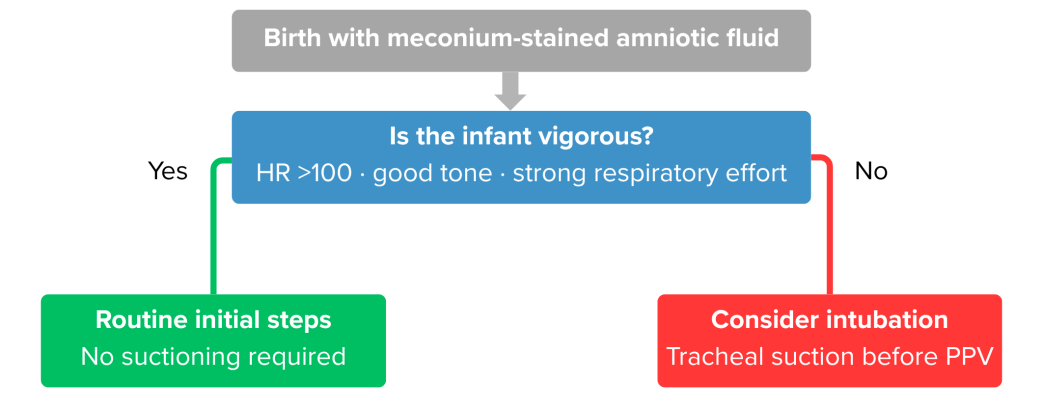
A vigorous infant (defined as one with a heart rate above 100 bpm, good muscle tone, and strong respiratory effort) proceeds through the routine initial steps without suctioning. Suctioning a vigorous infant does not improve outcomes and delays the initial assessment.
A depressed infant (one with absent or poor tone, inadequate respiratory effort, or bradycardia) warrants consideration of intubation and tracheal suctioning before PPV is initiated. This decision is made using clinical judgement, recognizing that the priority remains establishing effective ventilation. If intubation attempts are delayed or unsuccessful, PPV via face mask should begin without waiting.
The threshold for intubation in a depressed MSAF infant should be low. However, establishing effective PPV takes priority over any suctioning attempt if airway access is delayed.
Congenital diaphragmatic hernia (CDH)
CDH occurs when abdominal contents (most commonly bowel) herniate through a diaphragmatic defect into the thoracic cavity, compressing the ipsilateral lung and shifting mediastinal structures. The clinical recognition pattern in the delivery room includes: absent or reduced breath sounds on the affected side (usually left), bowel sounds in the chest, a scaphoid abdomen, and mediastinal shift.
The CDH modified resuscitation approach is summarised in Figure 10.
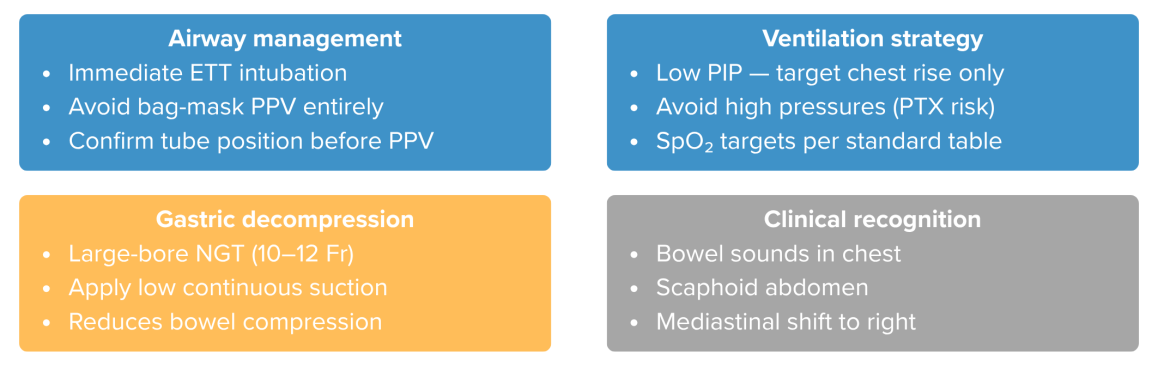
The critical point is that bag-mask ventilation is absolutely contraindicated in suspected CDH. Positive pressure delivered via mask inflates the stomach and bowel, worsening herniation and lung compression. Immediate ETT intubation is required. Following intubation, a large-bore nasogastric tube (10-12 Fr) is inserted and placed on low continuous suction to decompress the bowel and reduce compressive forces on the lung.
Ventilation pressures should be kept as low as possible, targeting minimal visible chest rise rather than standard PIP targets, to reduce the risk of pneumothorax in the contralateral lung, which is the only functional lung tissue available.
Choanal atresia
Choanal atresia is an obstruction of the nasal passages caused by failure of the posterior choanae to open. Neonates are obligate nasal breathers, so bilateral choanal atresia presents as immediate respiratory distress that worsens when the mouth is closed and relieves when the infant cries.
Diagnosis is confirmed by the inability to pass a 5-6 Fr catheter through each nare. Management is an oral airway (oropharyngeal airway) to bypass the nasal obstruction. The infant is stabilised and referred for surgical repair.
Pierre Robin sequence
Pierre Robin sequence is characterised by micrognathia, glossoptosis, and frequently a cleft palate. Micrognathia displaces the tongue posteriorly into the hypopharynx, causing airway obstruction. In the delivery room, prone positioning, which allows the tongue to fall anteriorly by gravity, is the first maneuver. If prone positioning does not establish adequate airway patency, an LMA is the preferred alternative airway; intubation is technically difficult in the Pierre Robin sequence because micrognathia distorts the normal anatomical landmarks.
Medically reviewed by: Kim Murray, RN, MS., Medical Educator

