PALS Certification vs BLS: Learn the Key Differences

PALS vs. BLS Certification at a Glance
Basic Life Support and Pediatric Advanced Life Support are both resuscitation certifications built on ILCOR's international CPR and emergency cardiovascular care guidelines, but they serve different roles. BLS covers cardiovascular care fundamentals – CPR, AED use, and choking relief – for patients of any age, making it the entry-level certification for nearly every clinical role. PALS teaches the pediatric-specific assessment and treatment skills needed to recognize and manage respiratory failure, shock, and cardiac arrest in infants and children, supporting a faster emergency response when pediatric emergencies occur.
Thank you for taking the time to complete this form.
What is BLS (Basic Life Support)?

BLS is the foundational resuscitation certification for nurses, EMTs, CNAs, medical assistants, dental professionals, and nursing students, along with other healthcare workers who provide hands-on patient care. Following ILCOR's unified Chain of Survival, BLS training teaches rescuers to
- Recognize cardiac arrest
- Deliver CPR, including high-quality chest compressions and rate for each age group
- Use an AED, including pad placement and rhythm analysis
- Clear a choking obstruction in adults, children, and infants through back blows, abdominal thrusts, or infant chest thrusts
AMC's BLS certification course adds airway management with mouth-to-mask and bag-mask ventilation, along with a physician-authored provider handbook and a free practice exam to review before the final test.
Because it doesn't assume prior medical training, BLS also serves as the foundation most advanced certifications, including PALS and ACLS, build on.
What is PALS (Pediatric Advanced Life Support)?
PALS is the advanced certification for clinicians who assess and treat critically ill infants and children. Its emphasis on this patient group is important because primary cardiac arrest is rare in pediatric patients, and arrest usually follows an underlying respiratory or shock condition. PALS training centers on catching those warning signs early, before a child progresses to full arrest, so healthcare providers can make a timely intervention rather than only responding once compressions and defibrillation are needed.
What PALS Training Covers
PALS training covers systematic pediatric assessment, recognition of respiratory distress and failure, shock, bradycardia, tachycardia, and cardiac arrest, along with pediatric-specific airway management, vascular access, medication dosing, and team dynamics. These skills support pediatric care in settings where rapid assessment and coordinated emergency care are essential.
AMC's PALS course is eligible for up to 8 AMA Category 1 Credits, twice what its BLS course offers, and also includes a physician-authored handbook, videos, and free practice test as AMC's other certifications.
Who Needs PALS Certification
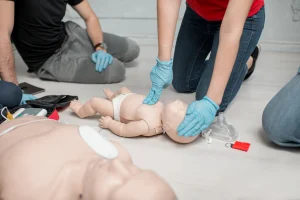
PALS is typically required for pediatric nurses, PICU and NICU staff, emergency department clinicians who treat children, pediatricians, and paramedics serving pediatric populations. It is especially relevant for clinicians working in emergency, intensive care, and critical care settings where pediatric emergencies may require immediate advanced treatment. Anyone whose patient population regularly includes infants or children benefits from the pediatric-specific assessment skills PALS adds beyond what BLS alone covers.
Key Differences Between PALS Focuses and BLS
Patient Age Groups
BLS applies to patients of any age: adults, children ages 1 to puberty, and infants under 12 months. PALS narrows its focus to infants and children only, using pediatric-specific algorithms for assessment, medication dosing, and resuscitation that account for smaller airways and faster deterioration than in adults.
Scope of Care and Skills
BLS teaches the fundamentals that keep a patient alive until advanced help arrives, such as compressions, breaths, and defibrillation. PALS adds the skills BLS doesn't cover, including pediatric vascular access, medication administration, and algorithms for bradycardia, tachycardia, and shock. These advanced skills help clinicians choose the right intervention as a child’s condition changes. Since compression technique also differs by age, PALS teaches the two-thumb encircling method for infants and one- or two-hand compressions for children, while BLS teaches the more straightforward adult CPR technique.
Prerequisites and Training Requirements
Most PALS programs expect you to already have pediatric BLS skills down. AMC's PALS course includes a built-in BLS refresher, so you don't need a separate BLS certification just to enroll. That said, many employers still require both certifications on file, so it's worth checking with yours first.
Where Advanced Cardiovascular Life Support (ACLS) Certification and CPR Fit In
BLS vs. ACLS
ACLS (Advanced Cardiovascular Life Support) builds on BLS the same way PALS does, but for adult patients. It adds EKG rhythm interpretation, cardiac arrest medications, and stroke and acute coronary syndrome management. While BLS is open to anyone providing patient care, ACLS is designed for healthcare providers who manage adult cardiac emergencies directly, including those working in intensive care, ER departments, and other critical care environments.
PALS vs. ACLS
PALS and ACLS cover similar ground, including airway management, medications, and team leadership for different patients. ACLS addresses adult cardiac emergencies and PALS addresses pediatric respiratory failure, shock, and cardiac arrest. Neither substitutes for the other, and providers who treat both adults and children often hold both certifications.
Cardiopulmonary Resuscitation (CPR) vs. BLS
CPR (cardiopulmonary resuscitation) refers to the core techniques of chest compressions and rescue breaths. BLS is the broader certification that includes CPR alongside AED use and choking relief, making BLS the more comprehensive credential and CPR the foundational skill within it.
How to Choose the Right Certification for Your Healthcare Role
Start with your patient population. If you provide general patient care across age groups, BLS covers what most employers require. If you work in a pediatric unit, PICU, NICU, or a general ER that treats kids, PALS offers the training you need. Many providers hold both, plus ACLS if they also manage adult cardiac emergencies. When in doubt, confirm with your employer or licensing board, since requirements vary by state, facility, and role.
Getting PALS and BLS Certified Online
Course Format and Time to Complete
AMC delivers both BLS and PALS entirely online, with no in-person skills evaluation or classroom attendance required. Course material includes videos, a physician-authored provider handbook, and a free practice test, and most learners finish the self-paced coursework and final exam in under an hour, saving progress automatically along the way. AMC's courses are accredited for continuing education credit through the Postgraduate Institute for Medicine and follow ILCOR's international guidelines, rather than a single national association's curriculum.
Certification Renewal
Both BLS and PALS certifications are valid for two years. AMC's recertification courses cover the same updated ILCOR guidelines as initial certification, in the same online, self-paced format, and at a lower price than first-time certification.
Frequently Asked Questions
No. BLS is the foundational certification covering CPR, AED use, and choking relief for patients of any age. PALS is an advanced, pediatric-specific certification that builds on BLS skills for infants and children.
Most employers expect both certifications on file, and PALS coursework assumes you're already comfortable with pediatric BLS skills. Check your employer's specific policy, since requirements vary by facility and role.
Yes, AMC's PALS course includes a pediatric BLS refresher before the advanced material, so current BLS certification isn't required to start. Many employers still want a separate, current BLS certification on file regardless.
Both are advanced certifications with comparable scope, covering airway management, medications, and cardiac arrest algorithms. PALS adds pediatric-specific dosing calculations that some learners find more demanding, while ACLS involves more complex EKG rhythm interpretation. Difficulty often comes down to which patient population feels more familiar.
PALS covers more material than BLS, including pediatric-specific algorithms and medication dosing, but AMC's self-paced format, provider handbook, and free practice test make it manageable without a classroom. Most learners complete the course in under an hour, with free unlimited retakes if they don't pass the first time.