
How to Renew CPR Certification

Whether you are a health care professional keeping your clinical credentials current or someone who wants to stay prepared for emergencies, the online CPR renewal process is straightforward - and with AMC, it can be completed entirely online in under an hour.
This guide covers everything you need to know: when to renew, how to do it step by step, what your options are, and how to make sure your renewed credential is accepted by your employer.
Thank you for taking the time to complete this form.
How Often Do You Need to Renew CPR Training Certification?
CPR certification is valid for two years from the date you pass your exam; a consistent window across all major certifying organizations and applies to CPR, AED and First Aid, BLS, ACLS, and PALS certifications.
It may seem like a short time for a professional certification to be active, but research shows that CPR skills begin deteriorating as early as six weeks after training. That means there is a good chance they won’t stay sharp, especially if you’re not reinforcing them regularly. Despite this, only 18% of Americans are currently up to date on their CPR training.
Another reason it’s important for CPR certificants to go through training and refresh regularly is that resuscitation protocols are always evolving. The International Liaison Committee on Resuscitation (ILCOR) continuously reviews resuscitation research to produce regular updates for the global healthcare community. That means a CPR certification earned before the most recent updates may not reflect current best practice.
Before You Start: What to Check on Your Current Card
Find Your Certification Expiration Date
Your expiration date is printed on your provider card, both on the digital version and any printed copy. If you completed your certification through AMC, your expiration date and certification history are also accessible in your AMC account. If you cannot locate your card, check the confirmation email sent we sent when you passed your exam.
Confirm the Certification Level Your Employer Requires
Before renewing, confirm with your employer's HR department or credentialing coordinator exactly which certification level they require. If your job requires CPR or BLS certification, verify the specific credential before enrolling. A general CPR, AED and First Aid certification is appropriate for most workplace, childcare, education, and community settings. Healthcare providers in clinical roles typically require Basic Life Support (BLS) credentials and advanced clinical roles may require ACLS or PALS in addition to BLS.
How to Renew CPR Certification Step by Step

Step 1: Check Your Expiration Date
Locate your current provider card or log into your AMC account and confirm your expiration date. If you are within three months of expiration, it’s a good time to begin the renewal process and avoid potential lapses.
Step 2: Choose an Accepted Renewal Course
Select a certification course that is accredited through a recognized CME provider, built on current ILCOR standards, and accepted by your employer. AMC's CPR, AED and First Aid recertification is accredited through the Postgraduate Institute for Medicine (PIM), jointly recognized by ACCME, ANCC, ACPE, ADA CERP, and AAPA. To put that simply, our single course satisfies CE requirements across physician, nursing, pharmacy, dental, and physician assistant roles simultaneously.
When evaluating any provider, look for a named accredited joint CME provider, a publicly accessible accreditation statement, disclosed medical faculty, and verifiable CE credit with Universal Activity Numbers.
Step 3: Complete the Online Course Materials
AMC's recertification course covers the same core content as initial certification, updated to reflect current ILCOR standards. A comprehensive digital handbook, videos, and audiobooks are all included with enrollment. The flexibly format saves your training progress automatically so you can start and stop as your schedule allows.
Step 4: Pass the Certification Exam
The exam consists of 20 multiple-choice questions with a passing score of 80%, drawn directly from the course content. We include unlimited free exam retakes with the purchase of a course, but be aware that each attempt will generate a new set of questions.
Step 5: Download and Sign Your Digital Card and Certificate
After you pass the exam, we will send your digital provider card and certificate instantly via email, giving your immediate access to both. Your card displays your name, course completion date, and expiration date. A printed card is also available by request.
CPR Renewal Options: Online, Blended, and In-Person
Online CPR Recertification Courses
The most efficient option for most providers. AMC's CPR, AED and First Aid recertification is 100% online, self-paced, and completable in under an hour - no classroom attendance, no in-person skills session, and no commute required. It is well-suited for workplace employees, educators, childcare providers, fitness professionals, and health care professionals whose employers accept fully online certifications.
Before enrolling in any online course, confirm that your employer's credentialing policy accepts fully online renewal. Most do - but confirming takes five minutes and eliminates any post-enrollment surprises.
Blended Learning
Blended learning combines an online didactic component with an in-person skills session. This format is common for BLS, ACLS, and PALS certifications where some employers require a documented hands-on evaluation. The online portion covers theoretical content at your own pace. The in-person component involves skills practice with a qualified instructor.
In-Person Classes
Traditional classroom courses are the most time-intensive option, with a typical duration of three to five hours for a standard CPR renewal. They involve instructor-led sessions, hands-on manikin practice, and a skills evaluation.
Renewing CPR, AED, and First Aid Together
AMC's CPR, AED and First Aid course covers all three in a single enrollment. You do not need to complete separate courses - the curriculum addresses CPR for adults, children, and infants, AED operation, choking relief, trauma management, and environmental emergencies together. Renewing all three simultaneously simplifies the credentialing process and ensures your coverage is consistent across all areas your employer may require.
BLS Renewal vs. CPR Renewal: Which One Do You Need?
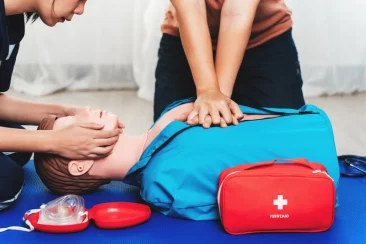
CPR, AED and First Aid certification is designed for lay responders, workplace staff, educators, and childcare providers. BLS is the provider-level credential required for most health care professionals in clinical settings. It covers the same core CPR skills but adds two-rescuer scenarios, rescue breathing, bag-mask ventilation, and team-based resuscitation content.
Consider a hospital medical assistant who has held a general CPR card for years. When their unit begins requiring BLS for all patient-facing staff, their existing card no longer satisfies the requirement - even though it has not expired. It’s helpful to understand the difference before renewing so you can avoid this situation entirely.
Letting Your Certification Expire: What Happens Next?
Most employers will not allow staff to work in roles requiring current certification without a valid card. In regulated settings, an expired card may trigger compliance issues for the facility as well as the individual.
There is also a clinical concern that goes beyond compliance. A provider who last trained two years ago under previous ILCOR guidelines may not have exposure to the 2025 CoSTR updates - including the revised choking response sequence, the updated infant compression technique, or the unified Chain of Survival. Acting on outdated training can be a real risk in an emergency, so we recommend renewing promptly if your certification has already lapsed.
Is There a Grace Period for CPR Renewal?
There is no formal grace period. Your card expires on the date printed on it, and most employers treat that as a hard deadline. Some sources suggest renewing within 30 days of expiration, but the safest approach is to never allow the card to lapse. That’s why we recommend starting the renewal process one to three months before your certification expires.
How Much Does CPR Certification Renewal Cost?
AMC's CPR, AED and First Aid recertification is $59, with all study materials and exam retakes included. For clinicians who need multiple certifications, bundle pricing helps: the ACLS and BLS bundle is $239, the ACLS, PALS, and BLS bundle is $318, and the CPR and Bloodborne Pathogens bundle is $79.
If your employer does not accept your AMC certification for any reason, AMC will refund your purchase in full.
What Changed in the Latest CPR Guidelines
The most current resuscitation standard is the 2025 ILCOR CoSTR, published in late 2025. For providers renewing after several years, the updates are more significant than a typical cycle, introducing meaningful changes across every major area of CPR practice:
- Unified Chain of Survival: The separate pediatric Chain of Survival has been retired. A single six-step framework now applies to adults, children, and infants: prevention, early recognition and activation of emergency response, high-quality CPR, defibrillation, advanced resuscitation, and recovery. Recovery is now formalized as the sixth link, reflecting evidence that cardiac arrest survival extends well beyond hospital discharge.
- Infant compression technique: The two-finger compression technique has been removed entirely. The two-thumb-encircling technique is now the standard for infant CPR in all scenarios after evidence showed it produces more consistent compression depth and superior hemodynamic outcomes.
- Compression-to-ventilation ratio: The 30:2 ratio is now explicitly preferred for trained rescuers, including health care providers, after previous guidance left more ambiguity around continuous compressions.
- Choking response sequence: Back blows now come before abdominal thrusts for adults and children over one year. The previous standard began with abdominal thrusts. This reversal is one of the most immediately noticeable changes for providers who trained under earlier cycles as the entire first-line response to severe choking has been reordered.
- CPR feedback devices: The 2025 ILCOR Education and Teams task force issued a strong recommendation supporting feedback device use during resuscitation training for both health care professionals and lay providers.
The choking response change alone is significant enough to affect real-world outcomes. A provider who trained two or three years ago and has not renewed may instinctively begin with abdominal thrusts even though it is now the second-line intervention, not the first. That kind of gap between trained response and current protocol is exactly what the two-year renewal cycle is designed to prevent.
How to Choose a CPR Renewal Course Employers Accept
Before enrolling anywhere, verify four things:
- The provider has a named accredited joint CME provider
- A publicly accessible accreditation statement is available
- A medical faculty are disclosed with conflict-of-interest documentation
- Verifiable CE credit is available with Universal Activity Numbers
Avoid providers that issue a card without a meaningful exam, claim accreditation from organizations with no independent existence, or cannot provide a verifiable accreditation statement on request. These are the hallmarks of a credential that will not hold up to employer scrutiny.
Renew Your CPR Certification Online Today
AMC's CPR, AED and First Aid recertification is $59, completable in under an hour, and built directly on the 2025 ILCOR CoSTR. Accredited through PIM and accepted by more than 98% of health care employers nationwide, it delivers your digital provider card the moment you pass. Get started on your recertification today.
Frequently Asked Questions (FAQs) About CPR Renewal
Can CPR be renewed online?
Yes. AMC's CPR, AED and First Aid recertification is 100% online with no in-person component required. Before enrolling, confirm that your employer accepts fully online certification - most do, but it is worth verifying in advance.
Does CPR need to be renewed yearly?
No. The standard renewal period is two years. Some employers in high-risk settings encourage annual skill refreshers between renewal cycles, but formal recertification is required every two years.
How long do I have to renew my CPR after it expires?
There is no formal grace period. Your certification expires on the date printed on your card. If your card has already lapsed, begin renewal promptly - the process is the same as standard renewal.
How much is a CPR certification renewal?
AMC's CPR, AED and First Aid recertification is $59, with all study materials and unlimited exam retakes included. Your digital provider card is issued instantly upon passing.
Is there a grace period for CPR renewal?
No. Employer policies typically treat the expiration date as a hard deadline. Renew before your card expires - starting the process one to three months in advance is the safest approach.
Frequently Asked Questions About CPR Training
Yes. CPR is lifesaving because it manually maintains blood circulation when the heart stops, delivering oxygen to the brain and vital organs during cardiac arrest. Without it, brain cells begin dying within minutes. Immediate bystander CPR can double or triple the chance of survival after out-of-hospital cardiac arrest, buying critical time until defibrillation and advanced care can restart the heart.
The 3 C's are Check, Call, and Compress. Check the person for responsiveness and assess the scene for safety. Call 911 or have a bystander call while you act. Compress — begin chest compressions immediately.
Not necessarily. According to the 2025 ILCOR guidelines, defibrillation pads must be placed on bare skin, but repositioning a bra rather than removing it is often sufficient to achieve proper pad placement. If clothing is interfering with proper hand placement for compressions or pad placement for defibrillation, it should be moved or removed as quickly as possible.
The 7 steps of CPR are: confirm scene safety, check responsiveness, call 911 and get an AED, check breathing, begin 30 chest compressions, open the airway and give 2 rescue breaths, and continue cycles while reassessing approximately every 2 minutes.