What Is CPR Certification?

Cardiac arrest affects nearly 600,000 people in the United States each year, and their survival often depends on how quickly someone nearby begins CPR (cardiopulmonary resuscitation). CPR keeps blood moving to the brain and heart when the heart stops. CPR certification documents that a person learned the current technique and passed an assessment of that knowledge.
This guide covers what CPR is, what a certification course teaches, which certification fits which role and how you can get certified online.
Thank you for taking the time to complete this form.
What Is CPR?
CPR is an emergency procedure for a person in cardiac arrest, when the heart stops pumping blood effectively. It does not restart the heart but rather sustains circulation until a defibrillator or emergency medical services can restore a normal rhythm.
What Does CPR Stand For?
CPR stands for cardiopulmonary resuscitation. "Cardio" refers to the heart, "pulmonary" refers to the lungs and "resuscitation" means reviving someone. The procedure supports both organ systems at once.
How CPR Works: Chest Compressions and Rescue Breaths
Chest compressions squeeze the heart between the breastbone and spine, pushing oxygenated blood to the brain and other vital organs. For adults, compressions run at 100 to 120 per minute at a depth of 2 to 2.4 inches, with full chest recoil between each one. Compressions that are too slow or too shallow fail to generate adequate blood flow. Rescue breaths replenish oxygen in the lungs, and compressions carry it to the tissues.
What Is CPR Certification?
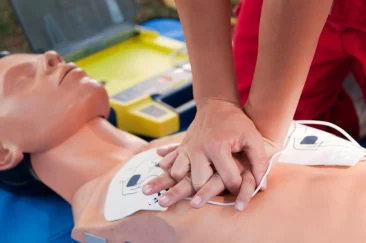
CPR certification is a credential issued after a person completes an approved CPR course and passes its exam. It carries a completion date and an expiration date that employers can verify. A current certification shows that its holder studied current resuscitation protocols and demonstrated that knowledge on a graded assessment. Employers, schools and licensing boards accept it as proof of training.
CPR Certification vs. CPR Training
Training is the learning while certification is the verified result. Anyone can complete AMC's free online CPR, AED and first aid course without taking an exam. A person who needs proof for a job needs certification, while a parent who simply wants the skill may only need training.
What Is Covered in a CPR Certification Course
AMC's CPR, AED and first aid course follows a provider handbook written by Dr. Karl Disque, a board-certified cardiac anesthesiologist. It is organized around the emergencies a rescuer is most likely to face.
Recognizing Cardiac Arrest and the Chain of Survival
A person who is unresponsive and not breathing, or only gasping, needs CPR. Gasping is an ineffective reflex common in cardiac arrest, not a sign of normal breathing. The course places CPR within the chain of survival: recognition and a 911 call, early CPR, rapid defibrillation, advanced care from EMS, hospital treatment and recovery. Each link in the chain depends on the one before it.
Adult, Child and Infant CPR
Technique changes with body size. Adults and adolescents past puberty receive two-handed compressions. For children age 1 to puberty, compressions reach about 2 inches, roughly one-third the depth of the chest. Infants under 1 receive compressions about 1.5 inches deep using the two-thumb encircling technique.
Using an AED
An automated external defibrillator analyzes heart rhythm and delivers a shock only when it detects a shockable rhythm. Learners practice powering the AED, exposing the chest, applying the pads, clearing the patient and following the voice prompts.
Choking and Rescue Breathing
Severe airway obstruction prevents coughing, speaking or breathing. Adults and children receive back blows and abdominal thrusts, while infants receive back slaps and chest thrusts. For rescue breathing, the head-tilt, chin-lift maneuver opens the airway, a pocket mask adds protection when available and each breath lasts about one second.
Current CPR Guidelines
The International Liaison Committee on Resuscitation (ILCOR) reviews resuscitation research and publishes treatment recommendations that national councils turn into guidelines. ILCOR's 2025 recommendations, reflected in AMC's current handbook, emphasize early CPR by lay rescuers. The risk of harm is low even if the person turns out not to be in cardiac arrest, so hesitation costs more than action.
Types of CPR Certification
CPR/AED and First Aid Certification
This is the standard credential for workplaces, schools, child care and the general public. AMC's course pairs CPR and AED use with first aid for bleeding, burns, stroke, seizures, allergic reactions and temperature-related illness.
BLS Certification for Healthcare Providers
Basic Life Support (BLS) builds on CPR for clinical settings, adding two-rescuer technique and team-based resuscitation for nurses, physicians, EMS crews, dental teams and other providers.
ACLS and PALS Certification
Advanced Cardiac Life Support (ACLS) and Pediatric Advanced Life Support (PALS) are for clinicians who manage arrests with medications, rhythm interpretation and advanced airway care. AMC's ACLS and PALS courses each carry up to 8 AMA PRA Category 1 Credits through joint accreditation with the Postgraduate Institute for Medicine.
Who Needs CPR Certification?
Many roles require current certification, including:
- Nurses, physicians and other clinical staff
- EMS crews and other first responders
- Child care providers
- Teachers and coaches
- Lifeguards
- Fitness instructors
- Flight attendants
Federal OSHA standard 1910.151 also requires adequately trained first aid responders at worksites without a nearby clinic or hospital. Some employers require an in-person skills check, so confirm requirements before enrolling.
How to Get CPR Certified Online
- Choose Your Course: Select the CPR, AED and first aid course, or BLS, ACLS or PALS if your role requires it.
- Complete the Course Materials: The course includes the handbook, video demonstrations and audiobook versions. Learners work at their own pace and can save progress, and those recertifying can skip directly to the exam.
- Pass the Exam: The CPR exam has 20 multiple-choice questions and requires a score of 80% to pass.
- Download Your Provider Card: A digital provider card is available immediately after passing, so proof of certification can reach an employer the same day.
How Long Does CPR Certification Last?
CPR certification is valid for two years from the completion date. That window exists because resuscitation science keeps evolving, and ILCOR publishes updated treatment recommendations every year. Research also shows that these hands-on skills such as compression depth and rate also decline without practice so renewing on time keeps both current.
CPR Recertification and Renewal
Recertification follows the same online process as initial certification. With AMC, you can choose the CPR For Life option at $149 and it covers every future renewal, which we estimate can save $1,500 over a career.
Benefits of Being CPR Certified
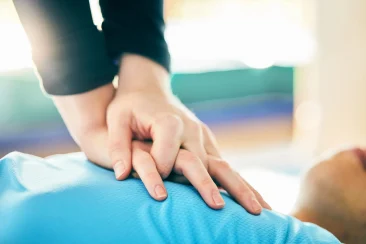
The biggest benefit is better odds of survival. In 2022 CARES data, about 11 in 100 people who got CPR from a bystander survived to leave the hospital, compared with 7 in 100 who did not. That is a survival rate about 60% higher.
For certain professions, a CPR certification helps you meet job requirements and supports professional development. For healthcare providers, AMC's CPR course qualifies for 6 Category 2 CME credits.
Frequently Asked Questions About CPR Certification
Is the CPR certification test hard?
The exam tests material covered in the handbook. It has 20 questions, requires 80% to pass and allows unlimited free retakes.
How long does it take to become CPR certified?
Most learners complete AMC's CPR course in under an hour. Learners can save their answers and return later, and those renewing a current certification can skip the course materials and go straight to the exam.
Can I perform CPR if I’m not certified?
Yes, untrained bystanders can give hands-only CPR with coaching from a 911 dispatcher. ILCOR notes that the risk of harm is low even if the person is not in cardiac arrest, so starting CPR is safer than waiting. Good Samaritan laws in every state protect people who give reasonable emergency aid in good faith.
How many years is a CPR certificate good for?
A CPR certificate is good for two years from the completion date printed on the provider card.
Does CPR need to be renewed every year?
No. Annual renewal is not the standard, though some employers set a shorter cycle by policy. Skills can fade within months without practice, so a brief review between renewals, such as AMC's free practice test, helps keep technique sharp.
How do I know if my CPR certification is still good?
Check the expiration date on your provider card or in your AMC account. The CertAlert+ app can send a reminder before it lapses.
Take the First Step Toward CPR Certification
Cardiac arrest gives no warning, and few people expect to be the one who has to respond. Certification replaces that moment of panic with a plan. Be the person who knows what to do, and get CPR certified with AMC today for $59, backed by AMC's 100% money-back guarantee.