Why ACLS Certification is Important for Healthcare Professionals

A patient's monitor alarms, and in the space of a breath, an otherwise quite shift turns into another life or death situation. There's no pause button to look something up or wait for the most experienced person to arrive. Whoever is standing at the bedside has to already know what comes next. That's the entire reason Advanced Cardiac Life Support (ACLS) exists and why it has become one of the most widely required certifications in health care. More broadly, advanced cardiovascular life support training gives providers a structured way to respond when every second counts.
ACLS is not merely a line item added to your resume to bolster a job application. It's the standardized skill set that turns a chaotic emergency into a coordinated response, which is exactly why hospitals, EMS agencies and outpatient clinics build it into their hiring and credentialing requirements. The importance of ACLS comes down to readiness and giving clinicians the knowledge and skills to respond to serious cardiac emergencies without losing time.
Thank you for taking the time to complete this form.
What Is ACLS (Advanced Cardiac Life Support)?
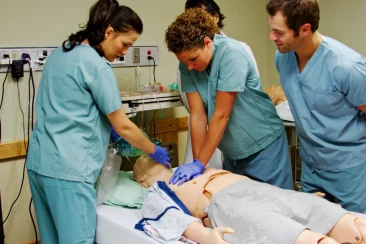
ACLS is a set of evidence-based algorithms for recognizing and treating cardiac arrest, stroke, and other life-threatening cardiovascular emergencies. These responses are simple enough to be committed to memory and recalled under moments of stress and have been developed through research, patient case studies, clinical studies, and the opinions of experts in the field. The structure it creates is what lets a group of people who may have never worked a code together before fall into step almost instantly, helping teams deliver more consistent patient care during high-stakes medical emergencies.
How BLS and ACLS Work Together
Basic Life Support (BLS) covers the fundamental skills needed in a cardiac or respiratory emergency. These include:
- High-quality chest compressions
- Rescue breathing
- Using an AED
ACLS picks up where BLS leaves off, teaching you what to do next once a patient needs more than compressions and a shock. ACLS-trained providers step in with advanced airway techniques, IV and IO access, cardiac medications and rhythm interpretation. These advanced skills are designed for complex cardiac events in which basic resuscitation alone may not be enough.
In short, BLS covers the first two minutes of a resuscitation effort while ACLS is everything that comes after, once the situation calls for more advanced tools. Together these life-saving skills help clinicians respond across a wider range of emergencies.
How ACLS Courses Equip Providers for Emergencies
A typical ACLS course covers:
- High-performance CPR and defibrillation
- Advanced airway management
- ECG rhythm recognition
- Medication administration, including epinephrine and amiodarone
- Team-based resuscitation and post-arrest care
Each piece connects to the next. A provider who can read a rhythm strip but hesitates on the airway, or who knows the drug doses but can't communicate them clearly under pressure, is only carrying part of the load. ACLS trains all of it together, because that's how it actually plays out in the room. All of it runs through a structured framework called the ACLS Survey consisting of Airway, Breathing, Circulation, and Differential diagnosis which gives providers a consistent way to work a case even when information is incomplete. In that sense, ACLS courses equip healthcare professionals to connect assessment, communication and treatment in one coordinated response.
The Role of ACLS in Emergency Care
CPR and a Faster, Structured Response to Cardiac Arrest
Survival in cardiac arrest depends heavily on how quickly the right interventions start, and ACLS works to close that gap. Instead of debating next steps mid-emergency, a trained team already knows to confirm the rhythm, defibrillate if indicated, secure the airway, and push the right medication at the right time. That speed is the whole point, especially during cardiac emergencies when a delayed response can affect patient outcomes.
ACLS also assumes a provider won't always have full information or equipment on hand. Someone running a code on the side of a road doesn't have arterial blood pressure monitoring or a crash cart, but the same framework still applies, just scaled to whatever's actually available. That adaptability should always be built directly into the training.
Standardized Care Across Every Setting
Whether a patient codes in the ICU, the emergency department, a dental chair or the back of an ambulance, ACLS means the response looks the same. A nurse floating to an unfamiliar unit or a traveling paramedic backing up a hospital team doesn't need a briefing on how things are done here. The algorithm is the algorithm, and that consistency removes a layer of guesswork exactly when there's no time for it. This consistency is especially valuable in emergency departments and intensive care units, where teams routinely manage unstable patients.
How Timely Intervention Supports Patient Survival
Outcomes track closely with how well a team executes the fundamentals: compressions at the right depth and rate, minimal interruptions, and defibrillation delivered without delay. ACLS training reinforces those fundamentals until they hold up under pressure, and it adds the pharmacological and airway management piece that keeps a patient stable once a rhythm returns. Faster, more coordinated treatment can improve patient outcomes and help teams save lives.
Why ACLS Is Important for Every Healthcare Provider
Who Needs ACLS Certification?
ACLS certification is standard for ICU and critical care nurses, emergency department staff, cath lab teams, anesthesiologists, hospitalists, paramedics and respiratory therapists. Anywhere a patient could deteriorate quickly, employers expect the people in the room to already be certified. It is particularly relevant for clinicians who work in emergency medicine or other settings where they may be among the first to respond to cardiac arrest, stroke or heart attacks.
ACLS for Critical Care and Career Advancement
For nurses especially, ACLS often marks the line between the units they can work and the ones they can't. Critical care, the ED and cardiac step-down units routinely list it as a requirement, not a preference. Adding ACLS to a resume opens those doors, and it's frequently a prerequisite for charge nurse or leadership roles where someone needs to be able to run a code, not just participate in one. For these clinicians, advanced cardiovascular life support certification demonstrates preparation for higher-acuity responsibilities.
Stronger Team Communication in Critical Situations
Picture a code where the charge nurse calls out, "Push one milligram of epi," and the nurse at the IV line repeats it back before administering it: "Pushing one milligram of epi now." That small exchange, known as closed-loop communication, is a core piece of ACLS training, and it's the kind of habit that prevents a missed dose or a doubled-up drug in the middle of chaos. Everyone in the room has a defined role so the team moves like it has rehearsed this exact moment before, because in a sense, it has. That coordination is part of what makes ACLS so life-saving in dire situations.
What ACLS Training Covers
Airway Management and Ventilation
Providers learn to secure and maintain an airway using techniques ranging from a bag-valve-mask to supraglottic devices and intubation, along with how to confirm placement and ventilate effectively without over-oxygenating or under-oxygenating the patient.
Rhythm Recognition and Defibrillation for Cardiovascular Emergencies
Reading an ECG under pressure is a different skill than reading one in a classroom. ACLS trains providers to identify shockable and non-shockable rhythms quickly and to act on that read without second-guessing it, whether that means defibrillation, synchronized cardioversion, or moving straight to medications.
ACLS Medications and Post-Arrest Care
Beyond knowing which drug treats which rhythm, ACLS covers dosing, timing and route of administration for medications such as epinephrine, amiodarone and atropine. It also addresses what happens after return of spontaneous circulation, including targeted temperature management, hemodynamic support and the monitoring that prevents a second decline.
Staying Current: ACLS Guidelines and Recertification
Renewing ACLS Certification for Nurses and Other Providers
Resuscitation science moves, and ILCOR used to revise its guidelines on a five-year cycle, with the last major update in 2020. That’s now changed as ILCOR maintains its recommendations on an ongoing basis rather than waiting for a scheduled release, making it even more important for certification to stay on its own set clock. A two-year renewal cycle keeps providers working from the current standard instead of whatever was correct when they first certified. It's less a bureaucratic hurdle than a built-in refresher, since skills like rhythm recognition and drug dosing get rusty without regular practice.
AMA Category 1 Credits and Continuing Education
ACLS certification typically counts toward continuing education requirements, and many courses, including Advanced Medical Certification's, are eligible for AMA PRA Category 1 Credits through an accredited reviewing body. For providers juggling license renewals, certifications and CE requirements at the same time, a course that satisfies more than one obligation at once is worth choosing deliberately.
How to Get ACLS Certified Online
This is where AMC's approach stands apart from a lot of what's out there. The course is 100 percent online and self-paced, and most providers finish it in under an hour, which matters for anyone trying to fit certification around back-to-back shifts rather than a weekend classroom seminar. It follows current ILCOR standards and is Joint Commission (JCAHO) compliant, so it holds up to the same scrutiny as in-person training.
Study materials include videos, audiobooks and in-browser modules, plus a free practice test to gauge readiness before the real exam. If a provider doesn't pass on the first attempt, retakes are unlimited and free, and the course is backed by a money-back guarantee. Once certified, providers receive an instant digital provider card, and AMC's ACLS courses are eligible for up to 8 AMA PRA Category 1 Credits through an accredited reviewer.
ACLS certification starts at $159, and for providers who'd rather not pay every two years, AMC's ACLS For Life option covers lifelong recertification with one upfront purchase. All you have to do is log in and pass the updated exam each cycle.
Get ACLS Certified with Advanced Medical Certification
Every day a certification lapses is a day a provider can't staff certain units, can't pick up certain shifts, and can't step into a code with full confidence. Advanced Medical Certification's online ACLS course removes every excuse to wait as it's 100 percent online, takes under an hour, starts at $159, and comes with unlimited free retakes and a money-back guarantee. There's no classroom to schedule around and no reason to keep postponing it.
Get certified with AMC today, walk away with your digital provider card and AMA Category 1 Credits, and step onto the floor ready for the moment that actually calls for it.
Frequently Asked Questions About ACLS
It equips health care providers to recognize and respond to cardiac arrest and other life-threatening emergencies quickly and correctly, and it's a requirement for most roles in critical care, emergency medicine and EMS.
To identify a life-threatening cardiovascular emergency early and restore stable circulation and breathing as fast as possible, minimizing damage and improving the odds of a full recovery.
The 4 T's are part of the reversible causes providers check for during cardiac arrest: tension pneumothorax, tamponade (cardiac), toxins and thrombosis (pulmonary or coronary). They pair with the 4 H's (hypovolemia, hypoxia, hydrogen ion (acidosis) and hyperkalemia/hypokalemia) as a checklist for what might be driving the arrest.
It's rigorous but manageable with the right preparation. Providers who study the algorithms and drug protocols beforehand generally do fine, and courses that include practice tests and unlimited retakes, like AMC's, take most of the pressure off a single attempt.
It depends on the provider. With AMC, a failed attempt simply means retaking the exam, since retakes are unlimited and included at no extra cost. Not every course offers that, so it's worth checking before enrolling.
The main difference between BLS and ACLS is the level of care each provides. Basic Life Support focuses on immediate lifesaving actions such as high-quality CPR, rescue breathing and AED use. ACLS builds on those skills with advanced interventions, including cardiac rhythm interpretation, medication administration, and coordinated team-based resuscitation.