
How AMC's PIM-Accredited Courses Compare to AHA Accreditation

When an employer reviews your ACLS, BLS, PALS, or CPR certification, they want to know three things:
- Is it current?
- Does it reflect recognized clinical standards?
- Was it issued by a provider they accept?
Advanced Medical Certification (AMC) answers all three of those questions. Our courses are accredited through the Postgraduate Institute for Medicine (PIM), a nationally recognized, independently governed continuing medical education provider. AMC's courses are accepted by more than 98% of health care employers nationwide, align with the latest ILCOR resuscitation science, and are Joint Commission (JCAHO) compliant.
Learn more about AMC’s accredited courses
Since 2011, AMC has certified hundreds of thousands of health care professionals across the country. If you’re eager to join their ranks but still have questions about online accreditation and the role of the American Heart Association (AHA) in the accreditation landscape, this page provides all the information you need before enrolling.
Thank you for taking the time to complete this form.
How AMC Is Accredited

AMC courses are accredited through a joint providership with the Postgraduate Institute for Medicine. In a joint providership, a non-accredited organization, such as AMC, partners with an accredited CME provider to plan, implement, and certify an educational activity. PIM takes responsibility for ensuring the activity meets all required standards for content integrity, educational design, and conflict-of-interest management.
Founded in 1979, PIM is jointly accredited by the following organizations, allowing a single AMC course to satisfy continuing education requirements across multiple disciplines simultaneously:
- Accreditation Council for Continuing Medical Education (ACCME)
- American Nurses Credentialing Center (ANCC)
- Accreditation Council for Pharmacy Education (ACPE)
- American Dental Association Continuing Education Recognition Program (ADA CERP)
- American Academy of Physician Assistants (AAPA)
AMC courses are developed and reviewed by Dr. Karl Disque, D.O., RPh, a board-certified physician and practicing anesthesiologist, and Kim Murray, RN, M.S. Both faculty members have disclosed no conflicts of interest in compliance with PIM's policy.'
The credit available through AMC courses include:
- ACLS and PALS Certification/Recertification: up to 8 AMA PRA Category 1 Credits™ / 8 ANCC contact hours / 8 ACPE CEUs / 8 ADA credits / 8 AAPA Category 1 CME credits
- Neonatal Resuscitation Certification: up to 8 AMA Category 1 Credits™
- Neonatal Resuscitation Recertification: up to 4 AMA Category 1 Credits™
- Basic Life Support (BLS) Certification/Recertification: up to 4 credits across all applicable disciplines
- ECG Resource, ACLS, and PALS Case Studies: up to 3 credits
- Advanced Cardiac Life Support (ACLS) and Pediatric Advanced Life Support (PALS) MegaCodes and Practice Tests: up to 2 credits
AMC's full accreditation statement and Universal Activity Numbers are available on the AMC accreditation page.
How AMC's Accreditation Compares to the AHA
AMC's courses are accredited through PIM and built on the same ILCOR resuscitation science that underpins all nationally recognized training. The American Heart Association plays a different role in that landscape: it publishes resuscitation guidelines and delivers training through its own network of authorized Training Centers, rather than accrediting outside providers. Both routes draw on the same underlying ILCOR science.
For anyone deciding where to certify, the practical comparison comes down to three things: who has independently accredited the provider, who developed and reviews the curriculum, and whether employers will accept the credential. AMC documents all three openly: PIM accreditation across five disciplines, a physician-led curriculum, and acceptance by more than 98% of U.S. health care employers.
How to Vet a Certification Provider
Accreditation means an independent, nationally recognized body has evaluated the provider’s courses against established educational standards and authorized them to issue continuing education credit. It cannot be self-designated, purchased, or claimed unilaterally. It requires external review and can be revoked if standards slip.
In medical continuing education, accreditation validates that course content is clinically accurate, educationally sound, and free from commercial bias, and it authorizes the provider to issue CE credits applicable toward licensure renewal and employer compliance. Without it, a course may teach useful skills, but its credits carry no professional weight.
The organizations that hold this authority are discipline-specific:
- ACCME is the primary accrediting body for physician CME
- ANCC accredits continuing nursing education
- ACPE oversees continuing pharmacy education
- ADA CERP is the American Dental Association program recognizing quality continuing dental education
- AAPA authorizes Category 1 CME credit for physician assistants
AMC is jointly accredited through the Postgraduate Institute for Medicine, which holds accreditation from all five of the above bodies. That means a single AMC course can satisfy continuing education requirements across multiple disciplines at once.
It is also worth distinguishing accreditation from approval and acceptance. Accreditation means a recognized body has authorized a provider to issue a continuing education (CE) credit. Approval means an institution has reviewed a course for a specific purpose. Acceptance means an employer will recognize the credential for compliance purposes. Most health care employers care about all three, and a provider that satisfies all three simultaneously is your best option for credentialing.
The Importance of ILCOR Science
The International Liaison Committee on Resuscitation is the global scientific body responsible for reviewing resuscitation research and issuing evidence-based recommendations worldwide. Its findings are published through the Consensus on Science with Treatment Recommendations (CoSTR), which forms the scientific foundation for resuscitation training standards globally.
AMC's curriculum is built directly on ILCOR standards and updated in alignment with the CoSTR process. Key 2025 CoSTR updates incorporated into AMC's training include refined guidance on defibrillator pad placement, vascular access during cardiac arrest, vasopressor use and post-ROSC care, CPR feedback devices, and expanded emphasis on teamwork training and in-situ simulation.
When ILCOR updates its recommendations, AMC’s curriculum reflects those changes. Certifying with AMC means training on current science, all reviewed by board-certified physicians, and validated by an accredited CME provider.
Joint Commission (JCAHO) and OSHA Compliance
JCAHO is the primary accreditation body for hospitals and health systems in the United States. Facilities that earn Joint Commission accreditation meet nationally recognized standards for patient safety and quality of care, and most major hospitals pursue it. As part of that process, clinical staff are expected to hold current certifications that reflect evidence-based standards.
The Joint Commission does not require staff to certify with any specific provider. Instead, it requires that certifications reflect current, evidence-based standards. AMC courses are built on current ILCOR guidelines and reviewed by board-certified physicians, which satisfies that standard.
OSHA Alignment
OSHA requires employers in many industries to maintain trained first aid personnel on staff. It also requires annual bloodborne pathogen training for workers who may come into contact with blood or infectious materials.
AMC's CPR, AED, and First Aid course and Bloodborne Pathogens certification course are both designed to meet these requirements. Group pricing is available for employers who need to certify an entire team.
What Employers Actually Require in a Certification
Most employers simply require current, nationally recognized certifications. Because AMC certifications are built on current ILCOR guidelines, they are accepted by the vast majority of health care employers nationwide. Before enrolling with us, confirm your employer's requirements directly with HR or your credentialing coordinator.
Ready to get certified? See AMC's accredited courses and enroll in minutes.
Why Choose an Accredited Online Provider Like AMC
AMC's courses carry the same scientific foundation and multi-discipline continuing education credit as any other ILCOR-grounded program. Here is what the experience of getting certified through our programs looks like:
- 100% online, self-paced access: No scheduled class times, no waitlists, no commute. Start, pause, and resume around your schedule. Most courses can be completed in under an hour.
- Lower cost than in-person alternatives: ACLS starts at $159, BLS at $119, PALS at $159, CPR at $59. Bundle pricing and group rates reduce costs further for teams.
- The same ILCOR-grounded curriculum: Courses are developed by board-certified physicians and built on current ILCOR standards, the same evidence base that informs all nationally recognized resuscitation training.
- Continuing education credit included: Eligible learners earn up to 8 AMA PRA Category 1 Credits™ for ACLS, PALS, or Neonatal Resuscitation certification, up to 4 for Neonatal Resuscitation recertification or BLS, with corresponding ANCC, ACPE, ADA CERP, and AAPA credit, all at no additional cost.
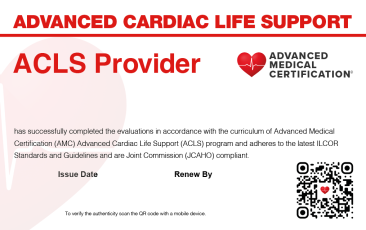
- Instant digital provider card: Available immediately upon passing, with a printed card available by request within five to seven business days.
- Money-back guarantee: If your employer does not accept your AMC certification, AMC will refund your purchase in full.
Why Health Care Professionals Trust AMC
Health care professionals also need to know that a certification provider has a real track record, that their credentials will be recognized when it counts, and that the courses they are investing time in are built to the same standard they hold their clinical practice to. AMC meets these standards with:
Over a decade of experience
AMC has been certifying health care professionals since 2011, building a track record of quality, acceptance, and learner satisfaction across more than a decade of operation.
Physician-designed curriculum
Every course is developed and reviewed by board-certified physicians and co-authored by clinical nursing faculty, ensuring content accuracy and clinical relevance.
98% national acceptance rate
AMC certifications are accepted by the vast majority of hospitals, health systems, clinics, and health care employers across the United States, backed by a full money-back guarantee.
Hundreds of thousands certified
More than 240,000 health care professionals have earned AMC certification, with over 11 million individuals empowered with life-saving skills through AMC and its affiliated programs.
Compliance across the board
AMC courses align with current ILCOR standards and guidelines, satisfy Joint Commission (JCAHO) requirements, and meet OSHA workplace safety standards where applicable.
What Health Care Professionals Say About AMC
"As the Credentialing Manager at Barton Associates, a locum tenens company serving clients nationwide, my team works with many doctors and nurse practitioners in need of certifications or certification renewal. Typically, these needs require a quick turnaround, and we have found AMC to be a high-quality, efficient, and fast solution. We recommend AMC to our providers and to anyone exploring AMC as an option for obtaining or renewing a certification."
- Whitney Jordan, Credentialing Manager, Barton Associates
"The digital card was accessible as soon as I passed my exam! I was able to show it to my employer the next day. The provider card came in the mail a couple of days after. AMC is fast and reliable! They get 2 thumbs up from me!"
- Dr. Tracy C., Physician
"I didn’t know that I could get my certification online, but Anne explained how their programs work and walked me through the whole thing. Signed up, passed the test! AMC, you are amazing!"
- Adam S., Nurse Anesthetist
Read more reviews from certified providers
Red Flags: How to Spot Fake Accreditation Claims
For health care professionals whose credentials are subject to employer review and credentialing scrutiny, choosing the wrong provider can mean wasted time, wasted money, and a certification that does not hold up when it matters. Here is what to watch for:
- Cards issued without any testing: A provider that issues a card upon purchase with no meaningful exam is selling a document, not a credential.
- Invented accrediting bodies: Names like "National CPR Board" or "National Health and Safety Council" have no independent existence or recognized authority. Verify any named body is publicly searchable and independently governed.
- Lifetime certifications: ACLS, BLS, PALS, and CPR certifications expire every two years because guidelines evolve. If an accreditor claims permanent certification, that means it’s bypassing standards that exist to protect patients.
- No verifiable CME or CE credit: A legitimate provider can name its accredited joint provider, provide Universal Activity Numbers, and point to a public accreditation statement. If they cannot, the credit claim may not be legitimate.
- No named physician oversight: Course content affecting clinical decisions in life-threatening situations should be developed by qualified clinicians. If a provider cannot identify its medical faculty, that is a meaningful quality gap.
- No public accreditation documentation: Legitimate providers publish accreditation statements, disclose faculty, and document conflict-of-interest compliance openly. If that information is absent, it may not exist at all.
Certified With Confidence: The AMC Standard
AMC is accredited through a joint providership with PIM, which holds accreditation from ACCME, ANCC, ACPE, ADA CERP, and AAPA. Our training is built on current ILCOR science, compliant with Joint Commission requirements, and aligned with OSHA standards, and our certifications are accepted by more than 98% of health care employers nationwide.
If you are ready to get certified in CPR, ACLS, BLS, BBP, and PALS through a provider that can back up every claim with documentation, you are in the right place.
Frequently Asked Questions About AHA Accreditation
The AHA publishes resuscitation guidelines and authorizes its own Training Centers; accreditation of outside providers comes from CME bodies like ACCME, ANCC, and ACPE, which is the route AMC's courses follow through PIM.
The phrase typically refers to a course delivered through an AHA-authorized Training Center. True CME accreditation comes from bodies like ACCME, ANCC, and ACPE.
"AHA-approved" refers specifically to courses delivered within the AHA's own Training Center network. AMC's certifications are accredited through PIM (a nationally recognized CME provider jointly accredited by ACCME, ANCC, ACPE, ADA CERP, and AAPA) and built on the same ILCOR-based resuscitation science accepted by health care institutions worldwide.
In most cases, yes. AMC certifications are accepted by more than 98% of hospitals, health systems, clinics, and health care employers across the United States. If your employer does not accept your AMC certification, AMC will refund your purchase in full.
AHA-approved refers to courses developed and delivered within the AHA's own proprietary training system. ILCOR-compliant means a course is built on the evidence-based recommendations published by the International Liaison Committee on Resuscitation, the global scientific body whose research informs the AHA's own guidelines. A course can be ILCOR-compliant without being AHA-branded, because ILCOR's recommendations are publicly available and form the scientific foundation for all nationally recognized resuscitation training programs, including AMC's.
Look for a named joint provider, a public accreditation statement, disclosed faculty with conflict-of-interest documentation, and verifiable CE credit with Universal Activity Numbers. AMC provides all four.
Yes. ACLS and PALS are each worth up to 8 credits across applicable disciplines. BLS is worth up to 4. Credit is included at no additional cost through the joint providership with PIM.
PIM is an independent CME provider founded in 1979, jointly accredited by ACCME, ANCC, and ACPE, and recognized by ADA CERP and AAPA. It serves as AMC's accredited joint provider.
Yes, provided the course is built on current ILCOR guidelines, developed by qualified clinicians, and accredited through a recognized CME provider. The format of delivery does not determine legitimacy. What matters is the scientific foundation of the curriculum, the qualifications of the faculty who designed it, and whether an accredited body has reviewed and certified it. AMC's online ACLS course satisfies all three criteria and is accepted by the vast majority of health care employers nationwide.
If your employer names AHA as the required provider, AMC is not the right fit. Confirm requirements with HR before enrolling in any course.