What Is Neonatal Resuscitation Certification? A Complete Guide for Health Care Professionals

The neonatal resuscitation certification is a credential for health care professionals who attend deliveries or provide care for critically ill newborns. It equips providers with the evidence-based knowledge and skills to respond to newborns who fail to establish adequate breathing or circulation at birth. Is it current?
Approximately 10% of newborns need some assistance breathing at birth, and a smaller percentage require more extensive resuscitation. In those critical first moments, the training and preparedness of the care team can determine the outcome. Neonatal resuscitation certification equips health care professionals with the evidence-based skills and team-based protocols to respond effectively in these dire moments.
AMC is not affiliated with, endorsed by, or connected to the American Academy of Pediatrics; AMC's neonatal resuscitation certification is an independent, ILCOR-based course and is not the AAP's NRP.
What is Neonatal Resuscitation Certification?
AMC's neonatal resuscitation certification course is designed by board-certified physicians and built on the latest guidance and standards set by the International Liaison Committee on Resuscitation (ILCOR). It is accredited through the Postgraduate Institute for Medicine (PIM), Joint Commission (JCAHO) compliant, and meets ILCOR and OSHA standards. Certification is valid for two years and accepted nationwide by hospitals, healthcare facilities, and health systems.
Thank you for taking the time to complete this form.
ILCOR is the global scientific body responsible for reviewing resuscitation research and issuing evidence-based recommendations worldwide. Its guidelines form the foundation of all nationally recognized resuscitation training, including AMC's neonatal resuscitation course.
Why Neonatal Resuscitation Certification Matters
Neonatal resuscitation certification exists to ensure that every delivery-room team shares the same evidence-based algorithm, communication protocols, and hands-on skills. When a resuscitation is needed, there is no ambiguity about who does what, in what order, or how the team communicates.
For most health care professionals working in labor and delivery, NICU, postpartum, or emergency settings, neonatal resuscitation certification is not optional, as the majority of U.S. birthing facilities require a current neonatal resuscitation provider credential for anyone who attends deliveries. For travel nurses and per diem clinicians, it is often a non-negotiable prerequisite before a first shift.
Who Needs Neonatal Resuscitation Certification
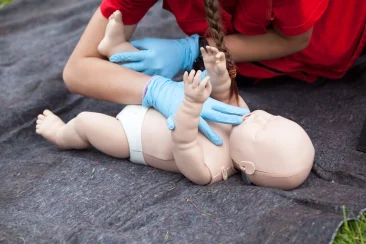
The specific requirement varies by role, facility, and clinical setting, but the common thread is the same: if there is a reasonable chance you will be present when a newborn needs resuscitation, neonatal resuscitation certification is expected.
Professionals who typically require or benefit from neonatal resuscitation certification include:
- Registered nurses in labor, delivery, and NICU settings
- Physicians in OB-GYN, neonatology, pediatrics, anesthesiology, and family medicine
- Certified nurse midwives (CNMs) and licensed midwives
- Respiratory therapists providing airway and ventilation support in the delivery room and NICU
- Paramedics, advanced EMTs, flight teams, and neonatal transport teams
- Physician assistants (PAs) and nurse practitioners (NPs) in perinatal, neonatal, or emergency care settings
- Medical and nursing students and residents on labor and delivery rotations
What Does Neonatal Resuscitation Certification Cover?
The curriculum is built around the neonatal resuscitation algorithm, which is a systematic, evidence-based decision-making sequence guiding providers through newborn assessment and management from the first seconds after delivery. The course is organized into the following modules:
- Foundations of neonatal resuscitation – the fetal-to-neonatal transition and the physiological basis for resuscitation
- Delivery room preparation – equipment, Apgar scoring, team roles, and family communication
- Initial assessment and the Golden Minute – rapid assessment, stimulation, and the decision to escalate
- Positive pressure ventilation (PPV) – initiating ventilation, assessing effectiveness, and corrective steps
- Advanced Airway Management – endotracheal intubation, laryngeal mask airway, and the airway algorithm
- Chest compressions – the two-thumb encircling technique, coordinated with ventilation in a two-person team
- Medications – epinephrine, vascular access, volume expansion, and glucose management
- Post-resuscitation care and stabilization – temperature, oxygenation, cardiovascular monitoring, HIE assessment, and transport
- Preterm and low birth weight resuscitation – physiological vulnerabilities, thermal management, ELBW, and periviable birth
- Special considerations – meconium-stained amniotic fluid, complex births, congenital heart disease, structural airway anomalies, hydrops fetalis, and multiple gestation
- Ethics and care at the end of life - non-initiation and discontinuation of resuscitation, family communication, comfort care, and team wellbeing
The Neonatal Resuscitation Certification Process
AMC’s course is 100% online and can be completed in under an hour. There is no classroom attendance, scheduled session, or commute.
Step 1: Enroll in the course: Select certification ($149) or recertification ($129) and create your AMC account. A PALS and neonatal resuscitation bundle is available for $249 for clinicians who need both.
Step 2: Complete the online course materials: Work through the handbook modules at your own pace. Study materials available to you after enrollment include videos, audiobooks, and a comprehensive digital handbook.
Step 3: Pass the exam: The certification exam is drawn from the course handbook and aligned with current ILCOR guidelines. Unlimited free exam retakes are included with your certification package.
Step 4: Receive your provider card: Upon passing, your digital Neonatal Resuscitation Provider Card is available instantly. A printed card is also available by request, and your certification is valid for two years.
Neonatal Resuscitation Prerequisites
Active health care license or student status
Open to nurses, respiratory therapists, physicians, advanced practice nurses, PAs, midwives, paramedics, and advanced EMTs.
Familiarity with newborn care
Neonatal resuscitation certification assumes a baseline understanding of perinatal and neonatal care.
BLS certification
A BLS certification is not a formal prerequisite, but most facilities require it alongside neonatal resuscitation certification. Completing BLS before beginning neonatal resuscitation preparation is strongly advised.
Cost, Time, and Format

Cost: Certification is $149, and recertification is $129. All study materials, videos, audiobooks, and exam retakes are included in the cost of the certification.
Time: The course can be completed in under an hour at your own pace. Progress is saved automatically, so you can start and stop as your schedule allows.
Format: AMC’s course is entirely online with no in-person component required. Certification follows ILCOR standards and learning objectives, making it thorough, reliable, and acceptable for most healthcare organizations.
Why ILCOR Alignment Matters
ILCOR is the global scientific body that reviews resuscitation research and issues evidence-based recommendations through the Consensus on Science and Treatment Recommendations (CoSTR). Its findings inform resuscitation training standards worldwide.
Key areas of the 2025 ILCOR updates incorporated in AMC’s curriculum include:
- Deferred cord clamping – current evidence supports deferring umbilical cord clamping for at least 60 seconds for most newborns not requiring immediate resuscitation
- Supraglottic airway devices – recommended as a reasonable alternative to face mask ventilation
- Umbilical cord milking – evidence supports intact cord milking as a reasonable alternative to early cord clamping for eligible newborns
- Sodium bicarbonate – the longstanding recommendation supporting its use has been formally withdrawn due to insufficient evidence.
- Briefing before resuscitation – evidence supports team briefing before every anticipated resuscitation to improve communication and preparation
Neonatal Resuscitation vs. Other Resuscitation Certifications
AMC’s neonatal resuscitation certifications are valid for two years, and renewal follows the same online format. Start the renewal process one to three months before expiration, as a lapse in certification can restrict assignments, pull you from L&D or NICU rotations, or delay travel nursing placements.
Neonatal Resuscitation vs. BLS
BLS covers foundational resuscitation for patients of all ages across broad clinical settings. Neonatal resuscitation is focused exclusively on the newborn in the immediate post-delivery period. Both involve airway management, ventilation, and compressions, but the clinical context and techniques are distinct. BLS is not a substitute for neonatal resuscitation training, and most facilities require both.
Neonatal Resuscitation vs. PALS
PALS covers respiratory distress, shock, and cardiac arrest in pediatric patients from infants through adolescence. Neonatal resuscitation training is limited to the newborn at delivery. The certifications are complementary, and AMC offers bundles for clinicians who need both.
An L&D nurse typically holds BLS and a neonatal resuscitation certificate, a NICU nurse may add PALS, and a neonatal transport team member may hold all three, plus ACLS for cardiovascular emergencies during transport.
Common Misconceptions About Neonatal Resuscitation Certification
“Neonatal resuscitation certification requires an in-person skills component."
AMC’s neonatal resuscitation certification is 100% online and requires no classroom attendance or in-person skills sessions.
"Neonatal resuscitation certification is only for nurses."
Neonatal resuscitation certification is designed for any health care professional involved in newborn care at birth, regardless of discipline – physicians, respiratory therapists, midwives, PAs, NPs, paramedics, and EMTs all hold neonatal resuscitation certification when their roles require it.
"BLS certification is required before neonatal resuscitation certification."
BLS is not a formal prerequisite, but most facilities require both. Completing BLS before beginning neonatal resuscitation training is strongly advisable.
Benefits of AMC’s Neonatal Resuscitation Certification
Neonatal resuscitation certification delivers value that extends well beyond meeting an employer's compliance checkbox. For health care professionals working with newborns, it is one of the most clinically meaningful credentials available.
- Career advancement: Neonatal resuscitation credentials are required or strongly preferred for L&D, NICU, neonatal transport, high-risk maternity roles, and travel nurses
- Up to 8 AMA PRA Category 1 Credits™: Included at no additional cost through the joint providership with PIM, with corresponding ANCC, ACPE, ADA CERP, and AAPA credit.
- Instant digital provider card: Available immediately upon passing, with a printed card available by request.
- Unlimited free exam retakes: No penalty for retakes. Each attempt generates a new set of questions.
- Money-back guarantee: If your employer does not accept your AMC certification, AMC will refund your purchase in full.
Special Considerations
For nursing and medical students
If your program does not require a neonatal resuscitation certificate before graduation and you are targeting L&D, NICU, or pediatric roles, pursuing certification before entering the job market removes a common onboarding hurdle.
For international health care workers
AMC’s certification is accepted nationwide, making it appropriate for internationally trained providers entering U.S. clinical settings.
For travel nurses and per diem clinicians
Start the renewal process two to three months before expiration, as a mid-contract lapse can delay or disqualify a placement.
How to Prepare for the Neonatal Resuscitation Exam
- Work through all course modules before taking the exam. The assessment is drawn directly from the handbook content.
- Practice applying the neonatal resuscitation algorithm to different patient presentations, such as a newborn with poor tone, a premature infant in respiratory distress, or a newborn unresponsive to initial stimulation.
- Take a practice test to identify weak content areas before you sit for the certification exam.
Ready to Get Neonatal Resuscitation Certified? Here Is Where to Start
The decisions made in the first minutes of a newborn's life depend on providers who are trained on current science, practicing current protocols, and prepared to act without hesitation. That is exactly what the neonatal resuscitation certification is designed to deliver.
AMC’s training course reflects the most up-to-date evidence-based resuscitation science, which means you get access to the latest protocols, the most current clinical techniques, and the updated neonatal resuscitation algorithm.
For health care professionals who attend deliveries, work in neonatal care, or may be called upon when a newborn needs resuscitation, AMC’s certification is accepted nationwide by most facilities. Enroll in AMC's neonatal resuscitation certification course today and bring the best possible to your clinical practice.
Frequently Asked Questions About Neonatal Resuscitation Certification
Neonatal resuscitation certification is a credential that validates a health care provider’s knowledge and skills in newborn resuscitation.
NRP stands for Neonatal Resuscitation Program. It is an educational program designed to train health care professionals in evidence-based neonatal resuscitation skills.
NRP is the program of the American Academy of Pediatrics; AMC separately issues its own fully online neonatal resuscitation certification, built on ILCOR guidelines and accredited through PIM.
Neonatal Resuscitation Provider Cards are valid for two years from the date of course completion, expiring at the end of the month in which the certification was earned. Renewal follows the same format.
Neonatal Resuscitation training is generally considered more demanding than BLS, particularly at the Advanced level. While BLS focuses on foundational resuscitation skills applicable across patient populations, neonatal resuscitation requires mastery of a specialized algorithm, neonatal-specific clinical techniques, and scenario-based decision-making under time pressure.
The AAP's NRP includes an in-person skills component, but AMC's neonatal resuscitation certification is a separate, fully online option completable in under an hour.
Neonatal resuscitation certification is required or strongly recommended for any health care professional who attends deliveries or cares for newborns in the immediate post-birth period. This includes L&D nurses, NICU nurses, physicians, respiratory therapists, certified nurse midwives, physician assistants, nurse practitioners, paramedics, and neonatal transport team members.
AMC's Neonatal Resuscitation certification is $149. Recertification is $129. A PALS + Neonatal Resuscitation bundle is available at $249. All study materials and exam retakes are included.
BLS is not a formal prerequisite for taking AMC's neonatal resuscitation course, but most facilities require both. Completing BLS first is strongly advisable.