
Why is CPR Considered a Life-Saving Technique?

CPR is lifesaving because it manually keeps oxygen-rich blood flowing to the brain and vital organs when the heart stops, buying critical minutes until the heart can be restarted. Without that sustained circulation, brain cells begin dying within minutes.
This article explains the science behind why CPR works, when it is needed, how to perform it correctly, and why getting certified matters for both health care professionals and members of the general public.
Thank you for taking the time to complete this form.
What Is CPR?
CPR stands for Cardiopulmonary Resuscitation. The name describes exactly what it does: cardio refers to the heart, pulmonary to the lungs, and resuscitation to the act of reviving someone who has lost normal heart and lung function.
In practice, the live-saving CPR technique combines two interventions:
- Chest compressions physically squeeze the heart to circulate blood through the body when it is no longer pumping on its own.
- Rescue breaths deliver oxygen to the lungs, which the compressions then distribute to the brain and vital organs.
Together, they replicate the function of a beating heart and breathing lungs during the critical period between cardiac arrest and the arrival of advanced medical care.
What Is Cardiopulmonary Resuscitation?
In cardiac arrest, the heart ceases its pumping action, stopping the flow of blood throughout the body. Within seconds, the brain – which accounts for roughly 2% of body weight but consumes about 20% of the body's oxygen – begins to be deprived of the oxygen it needs to survive. Brain cells start dying within three to four minutes of oxygen loss, and after nine minutes without blood flow, the damage can be irreversible.
By pressing down on the chest at the correct rate and depth, a rescuer physically compresses the heart and forces blood through the circulatory system. That circulation delivers what oxygen remains in the blood to the brain and other vital organs, slowing the deterioration that begins at the moment of cardiac arrest.
CPR's Role in the Chain of Survival
Every minute that passes without CPR after cardiac arrest reduces the chance of survival by roughly 10%. Immediate bystander CPR (someone performing before EMS arrives) can double or triple the chance of survival. That improvement is the difference between a reasonable chance of recovery and almost certain death.
CPR does not restart the heart, but defibrillation can shock it and restore a normal rhythm when the heart is in ventricular fibrillation or pulseless ventricular tachycardia. What CPR does is keep the brain viable and the heart responsive to defibrillation long enough for that intervention to work.
When to Start CPR Immediately
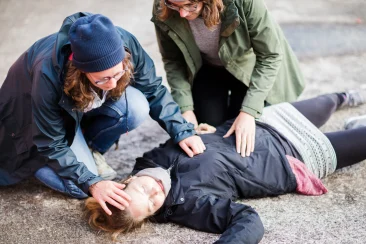
CPR can be life-saving any time a person's heartbeat or breathing has stopped or is inadequate to sustain life. The most common scenarios include:
- Sudden cardiac arrest — the heart stops beating due to an electrical disturbance, often with no warning
- Drowning — oxygen deprivation from water inhalation can stop the heart and breathing
- Choking — severe airway obstruction can lead to cardiac arrest if not relieved promptly
- Drug overdose or poisoning — respiratory depression from opioids or other substances can cause breathing to stop, leading to cardiac arrest
- Trauma — severe injury can cause cardiac arrest through blood loss, tension pneumothorax, or other mechanisms
- Respiratory emergencies — any condition that causes breathing to stop can progress to cardiac arrest if untreated
If a person is unresponsive and not breathing normally in any of these scenarios, begin CPR without delay. The 2025 ILCOR guidelines emphasize that the risk of harm from CPR performed on someone who is not in cardiac arrest is low. The importance of CPR in increasing survival rates is well documented and bystanders should not hesitate to initiate CPR if they are unsure.
How CPR Works: Steps, Ratio, and Position
The 3 C's of CPR
A useful framework for remembering the initial response to a potential cardiac emergency is the 3 C's:
Check
Assess the scene for safety, then check the person for responsiveness. Tap their shoulders and call out. If there is no response and they are not breathing normally, proceed immediately.
Call
Call 911 or have a bystander call while you begin CPR. Send someone to retrieve an AED if one is available nearby.
Compress
Begin chest compressions. Do not wait for the AED or for EMS to arrive. Every second of delay reduces the chance of survival.
The 7 Steps of CPR
- Confirm scene safety – Before approaching, ensure the environment is safe for you and the person in distress.
- Check responsiveness – Tap the person's shoulders firmly and call out. If there is no response, they are considered unresponsive.
- Call 911 and get an AED – Use a speakerphone or send a bystander to call EMS, then direct a specific person to retrieve the nearest AED.
- Check breathing – Look for normal breathing for no more than 10 seconds. If they are gasping or not breathing, they need CPR. Begin immediately.
- Begin 30 chest compressions – Place the heel of one hand on the center of the chest, on the lower half of the sternum. Place the other hand on top and interlace your fingers. With arms straight, compress to a depth of 2 to 2.4 inches at a rate of 100 to 120 compressions per minute.
- Open the airway and give 2 rescue breaths – Tilt the head back and lift the chin to open the airway. Pinch the nose closed, seal your mouth over theirs, and deliver two breaths lasting one second each. Watch for the chest to rise with each breath.
- Continue cycles and reassess – Continue cycles of 30 compressions and 2 breaths. Reassess approximately every 2 minutes or when the AED prompts you to do so. Continue until EMS arrives, the person begins to show signs of life, or you are physically unable to continue.
High-Quality CPR: Ratio, Hand Position, and Cycle Timing
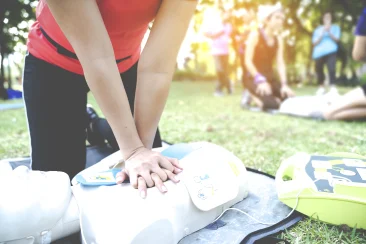
The standard compression-to-ventilation ratio for trained rescuers is 30:2 (30 compressions followed by 2 rescue breaths). Knowing how to do this is one of the most important CPR skills:
Hand placement also matters; position both hands on the center of the chest, specifically on the lower half of the sternum. Avoid pressing on the xiphoid process at the very tip of the sternum, as this can cause injury. Keep your arms straight and compress straight down, allowing the chest to fully recoil between each compression.
At the recommended rate of 100 to 120 compressions per minute, one cycle of 30 compressions and 2 rescue breaths takes approximately 15 to 18 seconds. Interruptions should be kept under 10 seconds. Continuous, high-quality compressions with minimal interruptions are the single most important factor in CPR effectiveness.
Using an Automated External Defibrillator (AED)
An AED is a portable device that analyzes a person's heart rhythm and delivers an electric shock to restore a normal rhythm. Using an AED alongside CPR allows you to maintain blood flow and keep the heart and brain viable. Many cases of cardiac arrest are the result of irregular, disorganized heart rhythms called ventricular fibrillation.
Most AEDs will have step-by-step instructions on them, so if one is available, you should use it as soon as possible while waiting for medical help.
Types of CPR (Hands-Only vs Conventional CPR)
Conventional CPR combines chest compressions with rescue breaths and is the recommended approach for trained rescuers, particularly health care providers. The 30:2 ratio ensures both circulation and oxygenation are maintained throughout the resuscitation.
Hands-Only CPR is recommended for untrained bystanders responding to an adult who has suddenly collapsed. It is simpler to perform under stress, eliminates hesitation about mouth-to-mouth contact, and is highly effective in the first several minutes after cardiac arrest, when residual oxygen in the blood is still sufficient to support circulation.
Adult, Child, and Infant CPR
The CPR technique required for those in cardiac arrest varies depending on the person's size and age. Adults and children past puberty receive CPR as described above: 30 compressions to a depth of 2 to 2.4 inches, two hands, 30:2 ratio.
Children ages 1 to puberty receive CPR with one or two hands depending on the child's size, compressing to approximately one-third the depth of the chest or about 2 inches, using a 30:2 ratio for one rescuer and 15:2 for two rescuers.
Infants under 1 year receive CPR using the two-thumb-encircling technique, which requires both thumbs placed side by side on the lower half of the breastbone while the hands wrap around the infant's chest. Compress to approximately one-third the chest depth, or about 1.5 inches.
Why CPR Training Matters
Research consistently shows that bystanders who have received CPR training are more likely to act, act faster, and perform higher-quality compressions than those who have not. Training in chest compressions and rescue breathing builds the confidence to execute technique during a real emergency.
Anybody Can Learn CPR
Furthermore, anyone can learn about administering CPR. In fact, the 2025 ILCOR guidelines emphasize that resuscitation training should be accessible to the broadest possible audience, from health care professionals to members of the general public. Research on CPR training in schoolchildren has demonstrated that even children as young as 12 can learn and perform chest compression technique and retain knowledge one to two months after training.
For health care professionals, CPR certification is typically a condition of employment and must be kept current. AMC's CPR, AED and First Aid course is built on current 2025 ILCOR standards and accredited through the Postgraduate Institute for Medicine (PIM). That multi-discipline accreditation means a single AMC course satisfies continuing education requirements across physician, nursing, pharmacy, dental, and physician assistant disciplines.
Knowing How to Perform CPR Can Save Lives
CPR works because it helps oxygen continue reaching the brain during a cardiac emergency. The research is clear that the faster CPR is applied, the better the person's survival odds. Even an immediate bystander who isn't an emergency medical professional can double or triple the chance that someone walks out of the hospital.
That outcome depends on people who know what to do and are willing to act. If you want to get the knowledge and training so you can act decisively and help those suffering from a cardiac emergency, AMC's CPR, AED and First Aid course will set you up for success. Get started and get certified today.
Frequently Asked Questions About CPR Training
Yes. CPR is lifesaving because it manually maintains blood circulation when the heart stops, delivering oxygen to the brain and vital organs during cardiac arrest. Without it, brain cells begin dying within minutes. Immediate bystander CPR can double or triple the chance of survival after out-of-hospital cardiac arrest, buying critical time until defibrillation and advanced care can restart the heart.
The 3 C's are Check, Call, and Compress. Check the person for responsiveness and assess the scene for safety. Call 911 or have a bystander call while you act. Compress — begin chest compressions immediately.
Not necessarily. According to the 2025 ILCOR guidelines, defibrillation pads must be placed on bare skin, but repositioning a bra rather than removing it is often sufficient to achieve proper pad placement. If clothing is interfering with proper hand placement for compressions or pad placement for defibrillation, it should be moved or removed as quickly as possible.
The 7 steps of CPR are: confirm scene safety, check responsiveness, call 911 and get an AED, check breathing, begin 30 chest compressions, open the airway and give 2 rescue breaths, and continue cycles while reassessing approximately every 2 minutes.