AHA vs Red Cross vs Advanced Medical Certification: Which BLS Certification Is Right for You?

If you are shopping for BLS certification, you will encounter three names more than any others: the American Heart Association, the American Red Cross, and independently accredited providers like Advanced Medical Certification. This article compares all three, including what each covers, what each costs, who accepts each, and how to make a confident decision before you enroll.
What All Three BLS Certifications Have in Common
All three programs build their BLS curricula on the same scientific findings and recommendations from the International Liaison Committee on Resuscitation (ILCOR). ILCOR is the global scientific body responsible for reviewing resuscitation research and publishing the Consensus on Science with Treatment Recommendations (CoSTR). Its findings form the evidence base for compression depth and rate, ventilation ratios, AED use, team dynamics, and every other core BLS skill. The AHA, Red Cross, and AMC all derive their course content from the same ILCOR evidence base, building on the skills you learn during CPR certification.
Thank you for taking the time to complete this form.
American Heart Association BLS: What to Know
The American Heart Association is the most widely recognized name in basic life support certification, particularly in U.S. health care settings. AHA publishes the Guidelines for CPR and Emergency Cardiovascular Care, which are developed in collaboration with ILCOR and adapted for U.S. clinical practice. Most major hospital systems, credentialing bodies, and health care employers consider the AHA course an acceptable credential.
- Format: AHA BLS is available in instructor-led classroom format and through HeartCode BLS, a blended learning option that combines an online cognitive component with a mandatory in-person skills evaluation.
- Acceptance: Most hospitals, health systems, and travel nursing agencies accept a BLS certification from AHA.
- Cost: Total cost varies by provider and format, typically ranging from $50 to $200 for initial certification and somewhat less for renewal, depending on the hosting institution.
- CE credit: AHA BLS does not independently carry accredited continuing medical education credit through the major discipline-specific bodies (ACCME, ANCC, ACPE, ADA CERP, AAPA). CME credit availability depends on the specific Training Center offering the course.
- Limitations: The mandatory in-person skills component requires scheduling, travel, and time away from work. Availability varies by location, and waitlists can be an issue in some markets.
American Red Cross BLS: What to Know
The American Red Cross has the broadest humanitarian mission and the most recognizable brand in emergency preparedness. Red Cross BLS follows ILCOR-derived guidelines and covers the same core skills as AHA BLS, including CPR for adults, children, and infants, AED use, two-rescuer scenarios, and choking relief.
- Format: Red Cross BLS is available in instructor-led and blended learning formats. Like AHA, the Red Cross requires an in-person skills evaluation for a provider-level card.
- Acceptance: Red Cross BLS is broadly accepted in education, childcare, community, and some health care settings. However, acceptance in clinical health care environments is not universal.
- Cost: Red Cross BLS typically ranges from $70 to $150, depending on format and location.
- CE credit: Like AHA, Red Cross BLS does not independently carry accredited CME credit through the five major discipline-specific bodies.
- Limitations: The primary limitation is acceptance variability in acute care settings. Red Cross BLS is an excellent credential in many contexts, but for health care professionals working in hospitals or taking travel contracts, the risk of an acceptance gap is worth understanding before enrolling.
Advanced Medical Certification BLS: What to Know
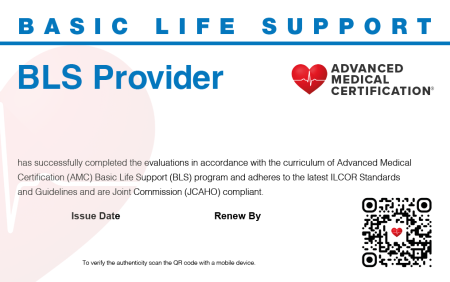
AMC offers a fully online BLS certification built directly on current ILCOR standards and accredited through the Postgraduate Institute for Medicine (PIM), an independently governed CME provider jointly recognized by:
- The Accreditation Council for Continuing Medical Education (ACCME)
- The American Nurses Credentialing Center (ANCC)
- The Accreditation Council for Pharmacy Education (ACPE)
- The American Dental Association Continuing Education Recognition Program (ADA CERP)
- The American Academy of Physician Assistants (AAPA)
That multi-discipline accreditation means a single AMC BLS course simultaneously satisfies continuing education requirements across physician, nursing, pharmacy, dental, and physician assistant disciplines.
- Format: AMC's BLS for healthcare providers, EMTs and paramedics, and nurses is 100% online, self-paced, and complete in under an hour. There is no scheduled class time, no in-person skills component, and no commute. Progress is saved automatically, and study materials include a comprehensive digital handbook, videos, and audiobooks with enrollment.
- Acceptance: AMC BLS certifications are accepted by more than 98% of health care employers nationwide, including major health systems like Adventist Health, CHS, SSM Health, and Trinity Health.
- Cost: BLS certification is $119. Recertification is $99. The ACLS and BLS bundle is $239, and the ACLS, PALS, and BLS bundle is $318, making it practical to align multiple certification renewals on a single timeline.
- CE credit: Up to 4 AMA PRA Category 1 Credits™ are included at no additional cost through the joint providership with PIM, with corresponding ANCC, ACPE, ADA CERP, and AAPA credit.
- Limitations: AMC's course is fully online with no in-person component. For the small number of employers whose credentialing policies require a skills verification on record, AMC may not satisfy that requirement. Confirm before enrolling.
Head-to-Head: AHA vs Red Cross vs AMC BLS
| Red Cross | AHA | AMC | |
|---|---|---|---|
| ILCOR-based curriculum | ✓ | ✓ | ✓ |
| Near-universal employer acceptance | X | ✓ | ✓ |
| PIM-accredited | X | X | ✓ |
| Multi-discipline CE credit included | X | X | ✓ |
| 100% online format | X | X | ✓ |
| Money-back guarantee | X | X | ✓ |
| Free practice test | X | X | ✓ |
| Instant provider card | X | X | ✓ |
Which BLS Certification Should You Choose?

The right answer depends on your role, your employer's requirements, and your priorities. Each of these options will help you build on your CPR training, teach you hands-on skills, including high-quality CPR, AED use, and airway management.
Choose AHA if your employer specifies it by name. If your hospital, health system, or travel nursing agency requires an AHA BLS Provider card, that is the card to get. AHA is one of the standards in acute care; the trade-off is logistics, since you will need to schedule and attend an in-person skills session.
Choose the Red Cross if your employer confirms it in writing. Red Cross BLS is a legitimate, ILCOR-derived credential that works well in education, childcare, community, and many health care settings.
Choose AMC if your employer's policy is written around standards rather than a specific brand. For most health care professionals, credentialing policies require a current, nationally recognized certification built on evidence-based protocols. AMC's BLS course is built directly on the 2025 ILCOR CoSTR, accredited through PIM across five disciplines, and accepted by more than 98% of health care employers nationwide. Plus, it includes multi-discipline CE credit at no extra cost, and delivers your provider card the moment you pass.
For clinicians who value efficiency, accreditation transparency, and CE credit, AMC is the stronger choice on every criterion that is not specifically about brand name recognition.
Get Your Online-Only BLS Certification
All three providers discussed in this article offer legitimate BLS certifications built on ILCOR science. The meaningful differences are in accreditation structure, format, CE credit, cost, and acceptance.
For health care providers whose employer policy is written around current, accredited, ILCOR-aligned training, AMC is the right choice. For $119 and as little as an hour of course time, your digital provider card is issued the same day you start the BLS training course. If your employer does not accept it, AMC will refund your purchase in full.
If you are not sure where to start, the free BLS practice test is available with no commitment required.
Frequently Asked Questions About Choosing the Right BLS Certifications
No. Most hospital credentialing policies are written around standards rather than a specific provider. AMC BLS certifications are accepted by more than 98% of health care employers nationwide.
Both programs build their curricula on ILCOR guidelines and cover the same core skills. The difference is not in clinical quality but in accreditation structure and employer acceptance. AHA BLS is more universally accepted in acute health care settings. Red Cross BLS is widely accepted in education, childcare, and community contexts, with variable acceptance in clinical environments.
Yes. AMC's BLS course is Joint Commission (JCAHO) compliant and built on current ILCOR standards, which is the standard the Joint Commission evaluates. The Joint Commission does not require staff to certify with any specific provider, just that certifications reflect current, evidence-based standards.
It depends on the provider. AHA and Red Cross BLS do not independently include accredited multi-discipline CME credit as a standard feature. AMC's BLS course includes up to 4 AMA PRA Category 1 Credits™ at no additional cost through the joint providership with PIM, with corresponding ANCC, ACPE, ADA CERP, and AAPA credit.
BLS certification is valid for two years from the date of completion, regardless of provider. Renewal follows the same format as initial certification. AMC's BLS recertification is $99, fully online, and can be completed in under an hour.
Yes, with AMC. AHA and Red Cross both require an in-person skills evaluation for a provider-level card. AMC's BLS course is 100% online with no in-person component required, and the resulting certification is accepted by more than 98% of health care employers nationwide.