
How Long Does CPR Certification Last

CPR certification is valid for two years from the date you pass your exam. That is the standard across all major certifying organizations and applies to CPR, AED and First Aid, BLS, ACLS, and PALS certifications. Your expiration date is printed on your provider card.
This guide covers why certifications expire, how long each course type lasts, and how to renew efficiently before your card lapses.
Thank you for taking the time to complete this form.
Why CPR Certification Expires
CPR Skills Decline Without Regular Practice
Research shows that CPR skills can begin to deteriorate as early as six weeks after training. In a real cardiac emergency, the quality of CPR delivered in the first minutes is one of the most significant determinants of survival. Certification renewal acts as a regular, structured refresh and reinforcement of the muscle memory that makes CPR effective in dire moments.
Guidelines and Protocols Change
The International Liaison Committee on Resuscitation (ILCOR), continuously reviews resuscitation research and updates the Consensus on Science with Treatment Recommendations (CoSTR). The 2025 CoSTR introduced meaningful changes including a unified Chain of Survival, updated infant compression technique, revised choking response sequence, and clarified compression-to-ventilation ratios. A CPR training certification earned before 2025 may not reflect these and other recent ILCOR recommendations, but AMC's CPR, AED and First Aid course has been updated to reflect the 2025 CoSTR throughout.
Employer and Workplace Requirements
Many employers, licensing boards, and regulatory bodies require a current CPR training certification as a condition of employment or continued licensure. In health care, education, childcare, fitness, and public safety settings, an expired card can restrict your ability to work, delay onboarding, or create compliance issues for your employer.
How Long Certification Lasts by Course Type
CPR, AED & First Aid Certification
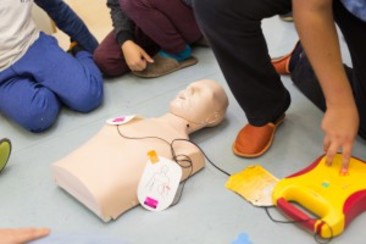
AMC's CPR, AED and First Aid certification is valid for two years and is designed for a broad audience, including health care professionals, educators, childcare providers, fitness trainers, and anyone who wants to know how to perform CPR during a cardiac or respiratory emergency. The course covers CPR for adults, children, and infants, AED use, choking relief, first aid, trauma management, and environmental emergencies.
BLS (Basic Life Support) Certification
BLS certification is also valid for two years and is the foundational credential for health care providers. It covers adult, child, and infant CPR, AED use, two-rescuer scenarios, and choking relief, and is required for most clinical roles.
ACLS (Advanced Cardiovascular Life Support) Certification
ACLS certification is valid for two years and is designed for health care professionals in high-acuity settings who manage cardiac arrest, stroke, bradycardia, tachycardia, and other cardiovascular emergencies. It builds on BLS competency with rhythm interpretation, medication administration, advanced airway management, and multi-step clinical algorithms.
PALS (Pediatric Advanced Life Support) Certification
PALS certification is valid for two years and is the pediatric equivalent of ACLS, designed for providers who manage cardiovascular and respiratory emergencies in infants and children. It covers pediatric-specific algorithms, weight-based dosing, and specialized resuscitation techniques.
How to Check If Your CPR Certification Is Still Valid
Your expiration date is printed on your provider card, both on the digital version and any printed copy you have requested. If you completed your certification through AMC, your expiration date and certification history are also accessible in your AMC account.
If you are unsure whether you still have an active card, check your email for the confirmation sent upon passing your exam, log in to your account with the provider you used, or contact their support team directly. AMC's customer support is available seven days a week via live chat, email, and phone.
How to Get CPR Certification Renewal
The most efficient approach to CPR renewal is to start the process one to three months before your card expires so you have adequate time to complete the CPR renewal course and receive your new card. The process is very straightforward:
Step 1: Enroll and study – AMC's recertification course is 100% online, self-paced, and completable in under an hour.
Step 2: Pass the exam – The exam covers current ILCOR-aligned content including CPR for adults, children, and infants, AED use, choking relief, and first aid. Unlimited free retakes are included.
Step 3: Download your card – Your digital provider card is issued instantly upon passing and emailed to you immediately, although a printed card is also available by request.
What Happens If Your CPR Training Certification Expires
Most health care employers will not allow staff to work without a current card. In regulated settings, an expired certification may also trigger compliance issues for the facility itself. Fortunately, if your certification has already lapsed, you do not necessarily need to restart a full initial course. At AMC, we offer recertification courses for those renewing after expiration.
Is Online CPR Certification Valid?
Yes, provided the course is built on current ILCOR standards, developed by qualified clinicians, and accredited through a recognized CME provider. What matters isn't usually the format, but the scientific foundation of the curriculum, the qualifications of the faculty who designed it, and whether an accredited body has reviewed and certified the course.
AMC's CPR, AED and First Aid course is designed by board-certified physicians, built on current ILCOR standards, accredited through the Postgraduate Institute for Medicine, Joint Commission compliant, and accepted by more than 98% of health care employers nationwide.
How Long Does Complete CPR Training Take?
AMC's CPR, AED and First Aid course can be completed in under an hour. The course is fully self-paced, and progress is saved automatically, so you can spread the material across multiple sessions if your schedule requires it. Study materials include a comprehensive digital handbook, videos, and audiobooks, all of which are included with enrollment.
Your Two-Year CPR Certification Duration Begins Today

The clock on your certification starts when you pass your exam, and the most practical approach is to renew before it expires rather than after, since a lapsed card can affect your employment status, compliance standing, and even the quality of care you are prepared to deliver.
AMC's CPR, AED and First Aid certification is built on current 2025 ILCOR standards, accredited through PIM, and accepted by more than 98% of health care employers nationwide. For just $59 and a few hours of work (or less), you can be CPR certified today.
Frequently Asked Questions about CPR Certification
CPR certification is valid for two years from the date of completion. This is the standard across virtually all certifying organizations and applies to CPR, AED and First Aid, BLS, ACLS, and PALS certifications.
No. The standard renewal period is two years. Some employers in high-risk settings may encourage annual skill refreshers or brief check-ins between renewal cycles, but formal recertification is required every two years, not every year. If your workplace requires annual updates, ask whether a skills refresher session satisfies that requirement separately from your formal certification renewal.
Your expiration date is printed on your provider card. If you completed your certification through AMC, log in to your AMC account to view your certification history and expiration date. You can also check the confirmation email sent when you passed your exam. If you need assistance locating your certification records, AMC's support team is available seven days a week via live chat, email, and phone.
First Aid certification, when bundled with CPR and AED training as in AMC's CPR, AED and First Aid course, is valid for two years. The two-year validity period applies across CPR, AED, and first aid content.
The most current resuscitation guidelines are the 2025 ILCOR Consensus on Science with Treatment Recommendations, published in late 2025. Key updates include a unified Chain of Survival for all ages, the removal of the two-finger infant compression technique in favor of the two-thumb-encircling technique, a preference for 30:2 compression-to-ventilation ratio for trained rescuers, and a back-blows-first approach for choking in adults and children.