
- Indications and Technique
- Coordination, Reassessment, and Escalation
Coordination, Reassessment, and Escalation
Coordinating compressions and ventilations
The 3:1 ratio is maintained using a verbal counting method: "one-and-two-and-three-and-breathe." Each number represents one compression; "breathe" is the cue for the airway provider to deliver one ventilation while compressions pause briefly. This produces the target rate of 90 compressions and 30 ventilations per minute.
The pause for ventilation should be minimal (just long enough for the chest to rise with the delivered breath). Prolonged pauses reduce overall compression fraction and diminish coronary perfusion. The compression and airway providers must work in close coordination, with the team leader calling the rhythm if needed.
Monitoring during compressions
During active compressions, ECG is the only reliable HR monitor, as pulse oximetry is inaccurate in low-perfusion states, and auscultation is impossible while you're doing compressions. ECG provides the most rapid and accurate heart rate information when a clinical decision depends on it.
Heart rate reassessment
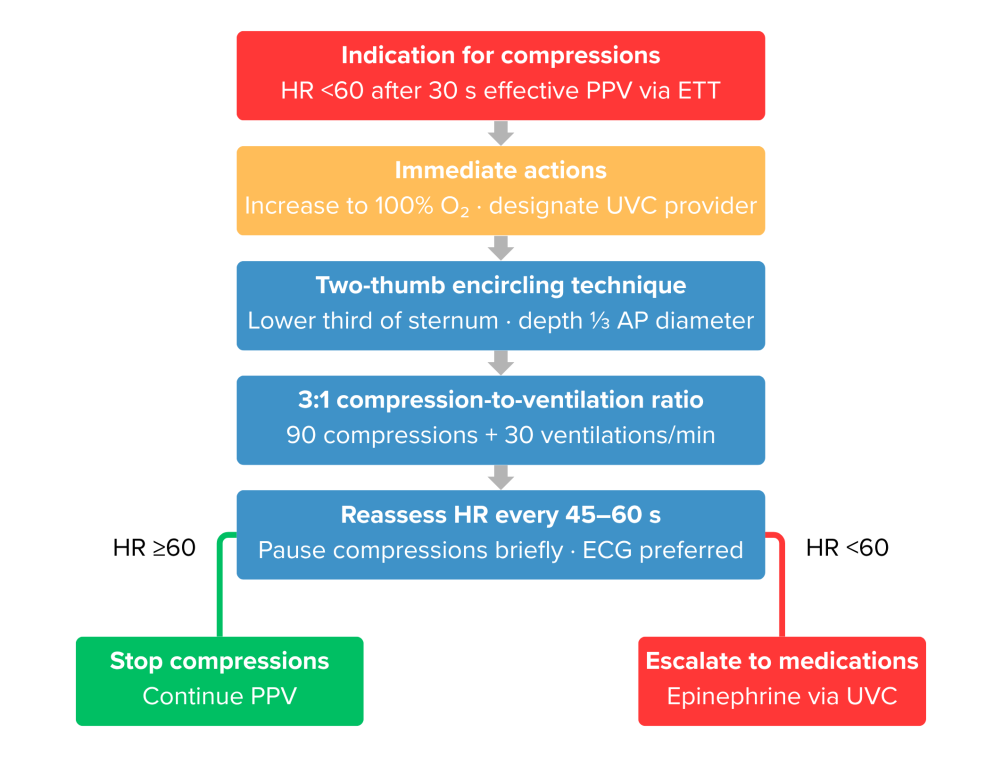
Heart rate should be reassessed approximately every 45-60 seconds during compressions. To reassess, compressions are paused briefly while heart rate is checked via ECG. The two possible responses determine the next action:
- Heart rate rises to 60 bpm or above: stop compressions, continue PPV, reassess for further improvement toward 100 bpm
- Heart rate remains below 60 bpm: resume compressions immediately and escalate to medications
Escalation to medications
If the heart rate remains below 60 bpm despite effective coordinated compressions and ventilation, epinephrine is indicated. This is covered in full in Module 7. At the point of escalation, the UVC should be in place, or insertion should be in active progress. Epinephrine via umbilical venous catheter is the preferred route, and preparation should not begin only after the decision to medicate has been made.
The full chest compressions decision pathway is summarized in Figure 5.
Do not stop compressions to prepare medications. Compression-ventilation cycles continue uninterrupted while the medications provider draws and prepares epinephrine for administration.
Medically reviewed by: Kim Murray, RN, MS., Medical Educator

