
- Epinephrine and Vascular Access
- Volume Expansion, Adjunctive Medications, and Glucose
Volume Expansion, Adjunctive Medications, and Glucose
Volume expansion
Suspect hypovolemia when the infant is pale, has weak pulses, and isn't responding to epinephrine. Volume expansion is indicated at this point.
Hypovolemia in the delivery room context is most commonly due to fetal blood loss (placental abruption, cord avulsion, or fetomaternal hemorrhage). Clinical indicators of hypovolemia include pallor persisting despite oxygenation, weak or absent pulses, and failure to respond to epinephrine despite effective CPR.
The dose is 10 mL/kg of normal saline administered intravenously over 5–10 minutes. Rapid infusion of volume in neonates (particularly preterm infants) carries the risk of intraventricular hemorrhage and should be avoided. Normal saline is the fluid of choice; blood products are not administered in the delivery room setting except in cases of confirmed massive haemorrhage managed by specialist teams.
Volume expansion is not a routine adjunct to epinephrine and should not be administered unless clinical indicators of hypovolemia are present.
Medications not used in active resuscitation
Three agents are commonly misunderstood in the context of neonatal resuscitation (Table 13):
Medication | Current guidance | Rationale |
|---|---|---|
| Naloxone | Not a resuscitation drug, used post-stabilisation only for suspected maternal opioid exposure | PPV is the correct response to respiratory depression regardless of cause; naloxone has a shorter half-life than many opioids and may cause acute withdrawal |
| Sodium bicarbonate | Not recommended during active resuscitation | Rapid infusion produces CO₂ which worsens intracellular acidosis; effectiveness unproven in cardiac arrest |
| Glucose (dextrose) | Not administered during resuscitation (post-resuscitation monitoring only) | Hypoglycemia develops after resuscitation, not during; glucose administration during arrest is not indicated |
Post-resuscitation glucose monitoring
Although glucose is not a resuscitation medication, hypoglycaemia is a significant post-resuscitation risk. All infants who have required resuscitation should have blood glucose checked within 30 minutes of stabilization. The threshold for treatment is a glucose level below 2.6 mmol/L (47 mg/dL) in the immediate newborn period. Early feeding or IV dextrose should be initiated promptly where hypoglycaemia is confirmed.
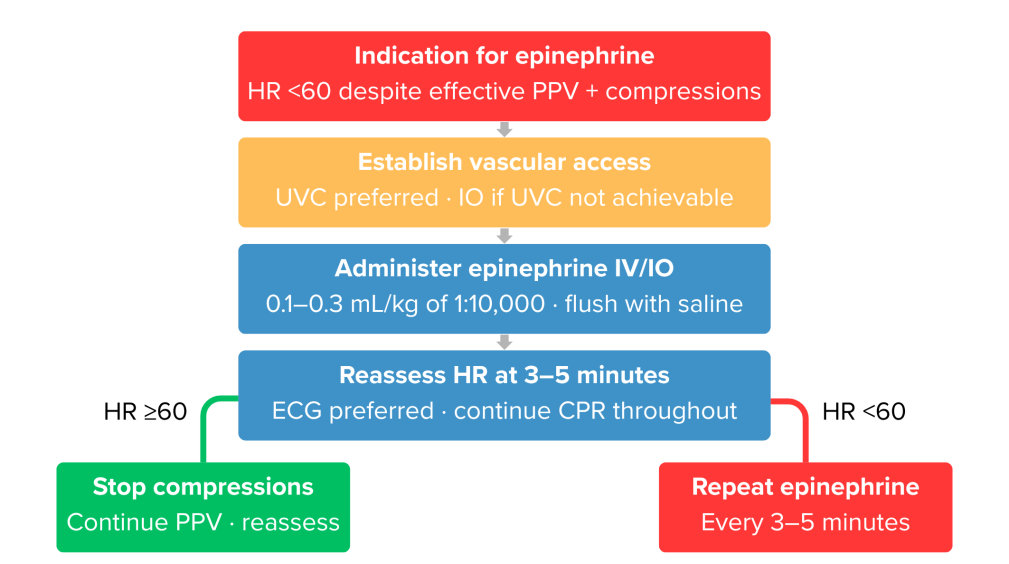
The full medications decision pathway is summarised in Figure 6.
Epinephrine will not compensate for inadequate CPR. Before each dose, confirm that PPV is producing chest rise, compressions are at the correct depth and rate, and the advanced airway is correctly placed.
Medically reviewed by: Kim Murray, RN, MS., Medical Educator

