
- Endotracheal Intubation
- Laryngeal Mask Airway and the Airway Algorithm
Laryngeal Mask Airway and the Airway Algorithm
The laryngeal mask airway
Current guidelines repositioned the laryngeal mask airway (LMA), also referred to as a supraglottic airway, in the resuscitation algorithm. It is no longer a backup-only device.
The LMA is particularly useful in three clinical situations:
- Face mask PPV has been ineffective despite corrective steps and intubation is not immediately achievable
- Anatomical features make intubation difficult (cleft palate, Pierre Robin sequence, micrognathia)
- The provider is trained in LMA placement but not in neonatal intubation
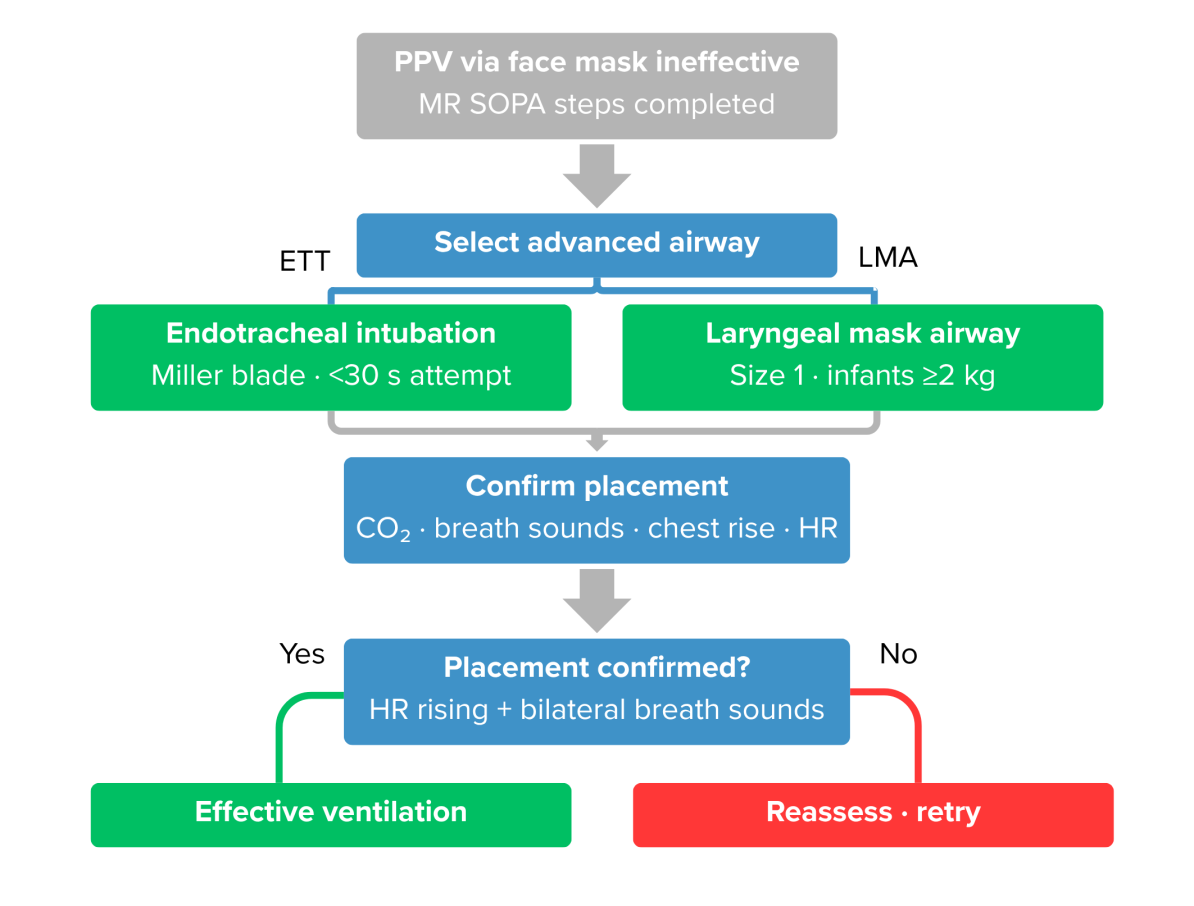
The size 1 LMA is appropriate for term and near-term infants above 2 kg. It is not recommended for infants below 2 kg or below 34 weeks gestation, where the device does not reliably form an effective seal.
LMA insertion technique
The LMA is inserted with the cuff deflated, advanced along the hard palate with the aperture facing downward until resistance is felt, then the cuff is inflated with 4 mL of air. Correct positioning produces a slight outward movement of the tube as the cuff seats against the glottic inlet. Ventilation is then initiated using the same parameters as face mask PPV.
Placement is confirmed using the same four-point method as ETT: CO₂ colorimetry, bilateral breath sounds, chest rise, and improving heart rate.
LMA limitations
The LMA does not protect against aspiration and cannot be used reliably for tracheal suctioning in meconium-stained cases. If the infant requires chest compressions, transition to ETT is recommended, as coordinated compressions and ventilations are more consistent via ETT. The LMA is a bridge to stabilisation; if the infant is not responding, intubation remains the definitive airway.
Umbilical venous catheter - connection to medications
The moment you're placing an advanced airway, designate someone for UVC insertion; don't wait until compressions are already running. If chest compressions are required following intubation, epinephrine will be needed. UVC insertion is covered in full in Module 7, but the team should designate a provider for UVC preparation at the point of advanced airway placement, not after compressions have begun.
The full alternative airway decision pathway is summarised in Figure 4.
Medically reviewed by: Kim Murray, RN, MS., Medical Educator

